The checks that decide whether a New York City homeowner ever recovers money
Recovery in this city is decided by four documents — a licence record, a workers' compensation form, a written contract and a dated cancellation notice — every one of them checked before anyone signs.
This is an independent reference. It is not a contractor. It does not sell, install, inspect, quote or repair roofing work, and it recommends no company. Nothing here is an inspection of your building or a determination about your contract, and no claim on this page rests on anyone here having installed a roof, hired a roofer or read your paperwork. The rules below come from the New York City Administrative Code, the Rules of the City of New York, the New York General Business Law, the New York Personal Property Law and the New York Workers' Compensation Law; where a provision of the New York City Construction Codes is cited, it is the 2022 edition.
Applies to
These requirements attach to the contract and the contractor, not to any part of the roof, so they do not vary by assembly. They do vary by building: "building" in § 20-386 of the New York City Administrative Code means a structure of no more than four dwelling units.
Key figures
- Home Improvement Contractor licence required above
- $200 aggregate contract price — and the exemption closes where a job is split to evade it
- § 20-387(a); § 20-397(5) New York City Administrative Code, Title 20, Subchapter 22 VERBATIM [AC 20-387]
- Written home improvement contract required above
- $500 statewide; a roofing contract requires a written contract at any price
- § 770; § 771; § 771-b(1) New York General Business Law, Article 36-A VERBATIM [GBL 771]
- Right to cancel, running from signature
- 3 business days until midnight of the third business day after signing, or after receiving the notice of the right to cancel, whichever occurs later
- § 20-394.1 New York City Administrative Code, Title 20, Subchapter 22 VERBATIM [AC 20-394.1]
- Accepted proof of workers' compensation coverage
- C-105.2 or U-26.3, SI-12, SIG-105.2 or CE-200. An ACORD certificate is not accepted.
- § 57 New York Workers' Compensation Law; NYS Workers' Compensation Board fact sheet VERBATIM [WCB C-105.2]
- Trust Fund, consumer claims cap
- $20,000 and $40,000 by trust fund invasion after an award, judgment or settled summons — neither available if the contractor was unlicensed
- § 2-224, eff. 2025-07-18 Title 6, Rules of the City of New York VERBATIM [6 RCNY 2-224]
- New York City small claims ceiling
- $10,000 a full roof replacement here exceeds it
- Small Claims Part New York City Civil Court, published limit, retrieved 2026-08-06 VERBATIM [NY COURTS]
 1
2
1
2
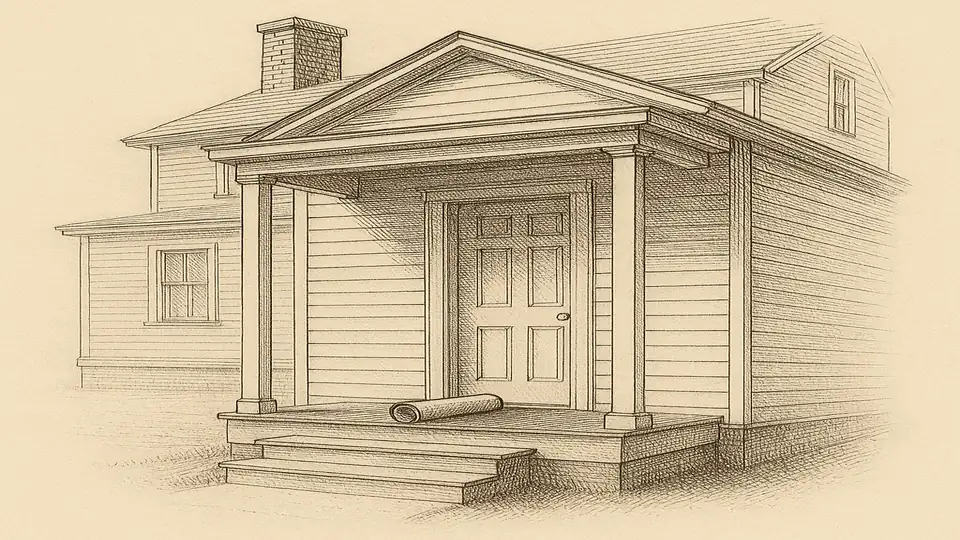
- The rolled document on the sill — the written contract that § 771-b of the New York General Business Law requires for roofing services, and that § 771 of the same law requires to carry named terms
- The threshold — a contract signed here starts the three-business-day clock in § 20-394.1 of the New York City Administrative Code, and may also start the door-to-door clock in § 427 of the New York Personal Property Law
Confirm the licence before anything else, because hiring an unlicensed contractor forfeits the largest recovery route in the city.
Section 20-387(a) of the New York City Administrative Code states that "no person shall solicit, canvass, sell, perform or obtain a home improvement contract as a contractor or salesperson from an owner without a license therefor."[AC 20-387] Section 20-386 defines home improvement to include repair, replacement and alteration of a residence in a building of no more than four dwelling units — the whole of the stock this survey covers. Section 20-397(5) exempts work priced under $200 in the aggregate, then closes the exemption: it does not apply where the work "is only part of a larger or major operation" or where "a division of the operation is made in contracts of amounts less than two hundred dollars for the purpose of evasion." No roof job on a house reaches that exemption honestly.
DCWP publishes a licence-status lookup[DCWP LOOKUP], and the same records sit in the city's open data as the Legally Operating Businesses dataset, searchable by business name or licence number and open to automated queries.[DCWP DATA] That dataset returned 1,239 active Home Improvement Contractor licences with a Staten Island business address, out of 12,892 active citywide, as of its refresh of 2026-04-24. The recorded field is a business address, not a service area, so an out-of-borough address on a licence establishes nothing.
What turns the lookup from a formality into the decisive act is DCWP's own statement about the Trust Fund, the mechanism through which a homeowner is repaid when a contractor takes money and does not finish:
“You are not eligible for Trust Fund repayment options if you use an unlicensed home improvement contractor.”
The licence check is therefore not a judgement about character. It is the step that keeps the city's repayment route open, and it cannot be taken retroactively.
A Home Improvement Contractor licence is a consumer-protection registration, not a test of roofing skill.
New York State has no roofing competency licence. The DCWP credential is obtained by passing an examination of 30 questions with 21 correct, and only one principal of the business — a sole proprietor, general partner, corporate officer, director, member or shareholder holding at least 10 percent — has to pass it.[DCWP CHECKLIST] The remaining requirements are financial and administrative: a $20,000 surety bond or $200 enrolment in the Trust Fund; a Sales Tax Certificate of Authority; a workers' compensation certificate or a Certificate of Attestation of Exemption; federal lead-renovation certification or a signed affirmation that it is not required; and fingerprinting for the principals.
Nothing in that list demonstrates that anyone can install a roof. It establishes that a legal entity exists, is bonded or enrolled, and can be made to answer a complaint — what a homeowner needs, and not what the licence is usually sold as.
An ACORD certificate is not proof of workers' compensation in New York; five named forms are.
The certificate handed over at the door is usually an ACORD form. Both DCWP and the New York State Workers' Compensation Board state that it does not satisfy the state's proof requirement:
“ACORD forms are not acceptable proof of New York State workers' compensation coverage.”
What section 57 of the New York Workers' Compensation Law accepts is a numbered form: C-105.2, issued by the carrier or a licensed New York agent rather than by the Board; U-26.3 from the State Insurance Fund; SI-12 for a self-insured employer; SIG-105.2 for group self-insurance; or CE-200, the Certificate of Attestation of Exemption, filed by a business that genuinely has no employees. Disability benefits and Paid Family Leave, under section 220(8) of the same law[WCL 57], are proved by DB-120.1 or DB-155. A contractor who is licensed or registered with the Department of Buildings must additionally carry commercial general liability cover of $1,000,000 under § 28-401.9 of the 2022 New York City Construction Codes.[AC 28-401.9]
The reason to care about a form number is section 240(1) of the New York Labor Law, which imposes liability for elevation-related injury on "all contractors and owners and their agents, except owners of one and two-family dwellings who contract for but do not direct or control the work."[LAB 240] The exemption has a condition written inside it, and whether it holds in a given case is case law this page has not opened. What the C-105.2 shows is that the crew on the roof is covered by somebody else's policy.
Read what you were handed against the City's own model contract, line by line.
Section 770 of the New York General Business Law defines a home improvement contract as one whose aggregate price exceeds $500 and names roofing expressly; § 771 lists what it must contain. Section 771-b(1) adds that "every roofing contractor shall enter into a written contract with an owner" for "roofing, gutter, downspout or siding services"[GBL 771-b] — with no dollar floor. DCWP publishes a model Estimate[DCWP ESTIMATE], a model Contract with Notice of Cancellation[DCWP CONTRACT], a Change Order form and a Permit Disclosure form[DCWP FORMS]. Those forms are the comparison document.
| What the document must carry | Where the requirement comes from | What to look for |
|---|---|---|
| The contractor's DCWP licence number | DCWP model estimate VERBATIM | Printed at the top of every page of the estimate. Check the number itself against the licence dataset. |
| Itemised materials with quantity, quality, brand, identifying features and estimated price | DCWP model contract; GBL § 771 | A single line reading "roof" with one number at the end is not this. |
| A yes/no record that brands were discussed, and warranties stated | DCWP model estimate VERBATIM | The form's own instruction on warranties is "If none, state none." A blank is not an answer. |
| Which permits are required, who obtains them, and a per-permit price line | DCWP model estimate and model contract; DCWP Permit Disclosure form | A written Permit Disclosure is to be given before the contract is signed, naming each permit's type, reason, who obtains it, the estimated fee and how to verify its status. |
| Approximate start and substantial-completion dates, with contingencies listed in writing | GBL § 771; DCWP model contract | Dates, not seasons. |
| Progress payments expressed as dollar amounts tied to specific stages of completion | GBL § 771; DCWP model contract | Percentages tied to nothing, or a schedule that front-loads the money, is the failure mode this term exists to prevent. |
| The workers' compensation certificate given to the consumer before work begins | DCWP model contract | Delivery of the certificate is a contract term, not a courtesy. |
| Written change orders signed by both parties before the changed work starts | DCWP model contract; DCWP Change Order form | This is the clause that governs everything discovered after the roof is opened up. |
| The mechanic's lien notice and the Lien Law § 71-a(4) escrow notice | GBL § 771 | Payments taken before substantial completion are the owner's property held in escrow, not the contractor's working capital. |
| The contractor's property and casualty insurance coverage and the insurer's contact information | GBL § 771, requirement added 2022-04-23 | A contract written from an older template will not have it. |
| The three-day cancellation legend, plus a separate Notice of Cancellation form, in the language the deal was negotiated in | GBL § 771; AC § 20-394.1; DCWP model contract | If the sale was made in a language other than English, both versions are required. |
Two provisions sit behind that table. Under § 20-394, no act, agreement or statement of an owner constitutes a waiver of any provision of the subchapter intended for the owner's benefit, so a clause signing these terms away does not do what it says. And DCWP states that home improvement contractors are not allowed to arrange or offer financing for a home improvement loan[DCWP TIPS] — the offer to arrange the money is itself a description of a prohibited act.
Five cancellation clocks exist, they start at different moments, and one does not start until the insurer says no.
Consumer content collapses these into "you have three days." They are separate rights under separate statutes, and one is commonly miscited: the door-to-door cancellation right lives in the New York Personal Property Law[PPL 427], not in General Business Law § 425, which is a coin-processor insurance statute. A federal rule runs alongside it.[16 CFR 429]
| Right | When the clock starts | What the text requires |
|---|---|---|
| New York City home improvement AC § 20-394.1 |
Signing, or receipt of the notice of the right to cancel — whichever occurs later | Until midnight of the third business day. The sole carve-out is an owner-initiated bona fide emergency, waivable only by a separate, dated, handwritten, signed statement. |
| New York State home improvement GBL § 771(1)(e) |
Signing | Notice of the right to cancel until midnight of the third business day is a required term of the contract itself. |
| Door-to-door sale PPL §§ 427, 428 |
The sale, at the buyer's residence | Until midnight of the third business day. The receipt or contract must be in the language of the oral presentation, the cancellation notice in not less than 10-point bold face type, and a refund is due within 10 business days. |
| Federal cooling-off rule 16 CFR Part 429 |
An in-person sale away from the seller's permanent place of business | Three business days, for sales over $25 at the buyer's home or over $130 at a temporary location. |
| Roofing contract after a claim GBL § 771-b(3) |
The owner's receipt of written notice from the insurer that all or part of the claim is not a covered loss | Cancellation prior to midnight on the third business day after that notice — which can be weeks after signature. |
The last row changes behaviour: a contract signed while a claim is pending carries a right that has not begun to run, and it starts on a document the insurer sends.
The deposit rule for roofing is stricter than the general guidance, and the two sources do not agree.
A repair contract is a contract, and the same checks decide it.
Nothing above is limited to a full replacement, and the thresholds sit low enough that a small job is squarely inside them. The licence requirement attaches above $200 under § 20-397(5), which also forecloses splitting a larger operation to stay under it. The roofing written-contract requirement in § 771-b(1) has no dollar threshold at all: gutter and downspout work is inside it. The contract-contents requirements in § 771 attach above $500, which a flashing or valley repair frequently exceeds.
Two model-form terms matter more on a repair than on a replacement. The change order, because repair work is diagnostic and the scope found on the roof routinely exceeds the scope written on the estimate; DCWP's model contract requires change orders in writing and signed by both parties before the changed work starts. And the itemised-materials term, because on a small job a lump sum conceals what was actually replaced. Section 20-395 adds a duty at any size: a contractor must affirmatively disclose that a written estimate of materials and labour is available, and may charge for it only if that is disclosed in advance.
A complaint reaches mediation, not a judgment, and every money route has a ceiling.
DCWP accepts complaints online without an account, by mail and by fax, in twelve languages, and resolves them through mediation.[DCWP] Between 2023-01-01 and 2026-08-05 the city's 311 records carry 156 Home Improvement Contractor complaints from Staten Island out of 2,084 citywide.[311] The agency's own reporting sets the expectation: in the first four months of fiscal year 2026, 828 complaints entered mediation across every industry DCWP regulates, 808 were resolved, and the median close was 32 days against a target of 28.[PMMR] Mediation is not adjudication and produces no enforceable judgment on its own.
Where mediation does not settle it, three bounded routes remain. The Trust Fund pays up to $20,000 through its consumer claims process and up to $40,000 by trust fund invasion following an award, judgment or settled summons, both effective 2025-07-18, and neither is available if the contractor was unlicensed. Small claims in New York City stops at $10,000, below the price of a roof replacement under any figure in this survey's cost research, so a full-roof dispute belongs in Civil Court. And CPLR 3015(e) makes a contractor's complaint dismissible where it fails to plead the required licence; the Appellate Division, Second Department, which covers Richmond County, has applied the rule to bar recovery by an unlicensed home improvement contractor.[CPLR 3015]
That last rule is a shield, not a sword: it stops an unlicensed contractor from suing to collect, and it is not authority for the proposition that a homeowner gets money back. One free check runs ahead of all of it — DCWP's guidance directs a homeowner to call 311 and ask for a Business Background Check, a different record from licence status that reports complaint history.
These checks are New York City's, and they do not travel.
Every requirement above is a creature of the New York City Administrative Code, the Rules of the City of New York, the New York General Business Law, the New York Personal Property Law or the New York Workers' Compensation Law. Outside the five boroughs the licensing regime, the contract-contents rules and the recovery routes belong to another state, and none of these section numbers carry over. As one illustration of a different regime, HEP is a Tennessee home-services contractor that operates under Tennessee licensing and Tennessee code and does not serve Staten Island or any part of New York City. Nothing about that company has been verified here and nothing is asserted about it.
What this page does not cover
It does not cover the physical work: what the code requires of the assembly, what a fair price is, or whether a scope is correct for a roof. It does not cover cooperative, condominium or rental situations, new construction or public work. It is not legal advice and not an evaluation of any contract, and no contractor is named, recommended, ranked or referred here.
When a filing or a licensed professional is actually required
The credential above is the consumer-facing one. Separately, a Department of Buildings permit is required where reroofing includes the roof deck or sheathing rather than stopping above it, and the Permit Disclosure is where that question first reaches paper; the permit line is set out at A DOB permit is triggered by the deck, not by a percentage of the roof. Above the $10,000 small-claims ceiling the forum is Civil Court, and a homeowner is dealing with a lawyer rather than a form. Where the roof structure will not carry an added load, or the deck is being replaced, the filing process requires a New York State registered design professional.
What this page does not establish
- Whether the section numbering used here for Title 20, Subchapter 22 matches the codified New York City Administrative Code. The text was read at a public mirror of the code, and DCWP's own published checklist and consumer materials state the same requirements. Opening the City's codified text would settle the numbering.
- The reporter citation for the Court of Appeals decision usually given for the rule that an unlicensed home improvement contractor cannot recover in quantum meruit. That opinion was not opened, so it is not cited here; the rule is attributed instead to CPLR 3015(e) and to a Second Department decision applying it. Pulling the Court of Appeals opinion would settle it.
- Whether a homeowner can recover money already paid to an unlicensed contractor. The established rule runs only in the other direction — the unlicensed contractor cannot sue to collect. A survey of Second Department decisions on restitution would settle it.
- Whether a homeowner can look up a Home Improvement Salesperson licence. The Administrative Code requires one, but DCWP's salesperson checklist page returns a 404 and the Legally Operating Businesses dataset returns no records for that category. A response from DCWP would settle it.
- What DCWP's complaint process produces for roofing complaints specifically. The mediation volumes and median closing time quoted here are agency-wide across every industry DCWP regulates. A per-industry breakdown, or the underlying complaint dataset filtered to the Home Improvement Contractor category with outcomes attached, would settle it.
- Whether the section 240(1) exemption for owners of one- and two-family dwellings holds in any given case. The statute conditions it on the owner not directing or controlling the work; the case law construing those words was not opened, and no page here states that the exemption is automatic.
- The current Department of Buildings alteration permit fee, and therefore the dollar figure a Permit Disclosure should name. Three incompatible per-$1,000 rates appear in the sources consulted, and DOB's current published fee schedule has not been opened. No fee figure is printed anywhere on this site until it is.
Sources
- [AC 20-387]
- City of New York. New York City Administrative Code, Title 20, Chapter 2, Subchapter 22 — Home Improvement Business, §§ 20-386, 20-387(a), 20-393, 20-394, 20-394.1, 20-395, 20-397(5). Read at a public mirror of the codified text; the requirements are independently stated in the DCWP documents below. nycadmincode.readthedocs.io · Retrieved 2026-08-06
- [DCWP CHECKLIST]
- NYC Department of Consumer and Worker Protection. License Application Checklist: Home Improvement Contractor, revised 2025-07-23. Examination, bond and Trust Fund enrolment, insurance and fingerprinting requirements. nyc.gov · Retrieved 2026-08-06
- [DCWP TIPS]
- NYC Department of Consumer and Worker Protection. Home Improvement Contractor Tips, revised 06/2026. Trust Fund eligibility, deposit guidance, the prohibition on contractors arranging financing, and the 311 Business Background Check. nyc.gov PDF · Retrieved 2026-08-06
- [DCWP LOOKUP]
- NYC Department of Consumer and Worker Protection. Check License Status. nyc.gov · Retrieved 2026-08-06
- [DCWP DATA]
- NYC Open Data. Legally Operating Businesses, dataset w7w3-xahh, Department of Consumer and Worker Protection. Counts of active Home Improvement Contractor licences by business-address borough; data as of the dataset refresh of 2026-04-24. Scope: New York City; the recorded field is a business address, not a service area. data.cityofnewyork.us · Retrieved 2026-08-06
- [DCWP ESTIMATE]
- NYC Department of Consumer and Worker Protection. Home Improvement Estimate (sample). Licence number at the top of every page; brands-discussed checkbox; warranties, "If none, state none"; permits and who obtains them; initials on every page. nyc.gov PDF · Retrieved 2026-08-06
- [DCWP CONTRACT]
- NYC Department of Consumer and Worker Protection. Home Improvement Contract and Notice of Cancellation. Itemised materials; per-permit price line; progress payments by stage; workers' compensation certificate before work begins; written change orders before changed work; mechanic's lien and Lien Law § 71-a(4) notices; both languages where the contract was negotiated in a language other than English. nyc.gov PDF · Retrieved 2026-08-06
- [DCWP FORMS]
- NYC Department of Consumer and Worker Protection. Home Improvement Change Order Form and Permit Disclosure. Change order PDF · Permit disclosure PDF · Retrieved 2026-08-06
- [DCWP]
- NYC Department of Consumer and Worker Protection. File a Complaint. Online, mail and fax routes; forms in twelve languages; complaints resolved through mediation. nyc.gov · Retrieved 2026-08-06
- [6 RCNY 2-224]
- City of New York. Rules of the City of New York, Title 6, § 2-224 — Home Improvement Contractor Trust Fund. Trust fund invasion cap $40,000; consumer claims cap $20,000; both effective 2025-07-18. rules.cityofnewyork.us · Retrieved 2026-08-06
- [GBL 771]
- New York State. General Business Law, Article 36-A — Home Improvement Contracts, §§ 770 and 771. Definition and $500 threshold; required contract contents, including the insurance-disclosure term added 2022-04-23. § 770 · § 771 · Retrieved 2026-08-06
- [GBL 771-b]
- New York State. General Business Law § 771-b — Roofing contractors. Subsection (1), written contract for roofing, gutter, downspout or siding services; subsection (3), cancellation running from the insurer's written notice of a non-covered loss. nysenate.gov · Retrieved 2026-08-06
- [PPL 427]
- New York State. Personal Property Law, Article 10-A — Door-to-Door Sales Protection Act, §§ 427 and 428. Third-business-day cancellation; notice in not less than 10-point bold face type; refund within 10 business days. Not General Business Law § 425, which concerns a different subject. § 427 · § 428 · Retrieved 2026-08-06
- [16 CFR 429]
- U.S. Federal Trade Commission. 16 CFR Part 429 — Rule Concerning Cooling-Off Period for Sales Made at Homes or at Certain Other Locations. Over $25 at the buyer's home; over $130 at a temporary location. ecfr.gov · Retrieved 2026-08-06
- [WCB C-105.2]
- New York State Workers' Compensation Board. Required Coverage for Businesses Applying for Government Permits, Licenses or Contracts. ACORD forms not acceptable; C-105.2, U-26.3, SI-12, SIG-105.2, CE-200; DB-120.1 and DB-155 for disability and Paid Family Leave. wcb.ny.gov PDF · Retrieved 2026-08-06
- [WCL 57]
- New York State Workers' Compensation Board. Permits, Licenses and Contracts — Workers' Compensation Law § 57 and § 220(8), applying to original issuance and renewal. wcb.ny.gov · Retrieved 2026-08-06
- [AC 28-401.9]
- NYC Department of Buildings. 2022 New York City Construction Codes, General Administrative Provisions, Chapter 4 — Licensing and Registration of Businesses, Trades and Occupations, § 28-401.9. Commercial general liability of $1,000,000 plus workers' compensation and disability benefits. nyc.gov PDF
- [LAB 240]
- New York State. Labor Law § 240 — Scaffolding and other devices for use of employees, subsection (1), including the exception for "owners of one and two-family dwellings who contract for but do not direct or control the work." nysenate.gov · Retrieved 2026-08-06
- [CPLR 3015]
- New York State Unified Court System. Brightside Home Improvements, Inc. v. Northeast Home Sec. LLC, 2022 NY Slip Op 04785, Appellate Division, Second Department — application of CPLR 3015(e) to an unlicensed home improvement contractor. nycourts.gov · Retrieved 2026-08-06
- [NY COURTS]
- New York State Unified Court System. New York City Small Claims Court — $10,000 limit; Richmond County Civil Court, Small Claims Part. nycourts.gov · Retrieved 2026-08-06
- [PMMR]
- NYC Mayor's Office of Operations. Preliminary Mayor's Management Report, Fiscal Year 2026 — Department of Consumer and Worker Protection. Complaints entering mediation, complaints resolved, and median days to close, first four months of fiscal 2026, all regulated industries. nyc.gov PDF · Retrieved 2026-08-06
- [311]
- NYC Open Data. 311 Service Requests from 2010 to Present, dataset erm2-nwe9. Complaints recorded against the Department of Consumer and Worker Protection "Home Improvement Contractor" complaint type by borough, 2023-01-01 to 2026-08-05. data.cityofnewyork.us · Retrieved 2026-08-06