Offering to cover your deductible is prohibited by General Business Law § 771-b
New York wrote a statute for roofing contractors alone, and it makes the advertisement unlawful on its own terms — before an invoice is written, before an insurer pays anything, and whether or not the roof is ever touched.
This is an independent reference. It is not a contractor, it sells nothing, and it refers no one. Nothing here is an inspection, a determination about your building, or an opinion about your insurance claim, and no one associated with it has installed a roof, hired a roofer or handled a claim. The rules on this page are statutes and agency rules rather than construction code; where a construction-code section is named it is the 2022 New York City Construction Codes, effective November 7, 2022. Statutes change, and the retrieval date of every document is printed in the Sources list.
Applies to
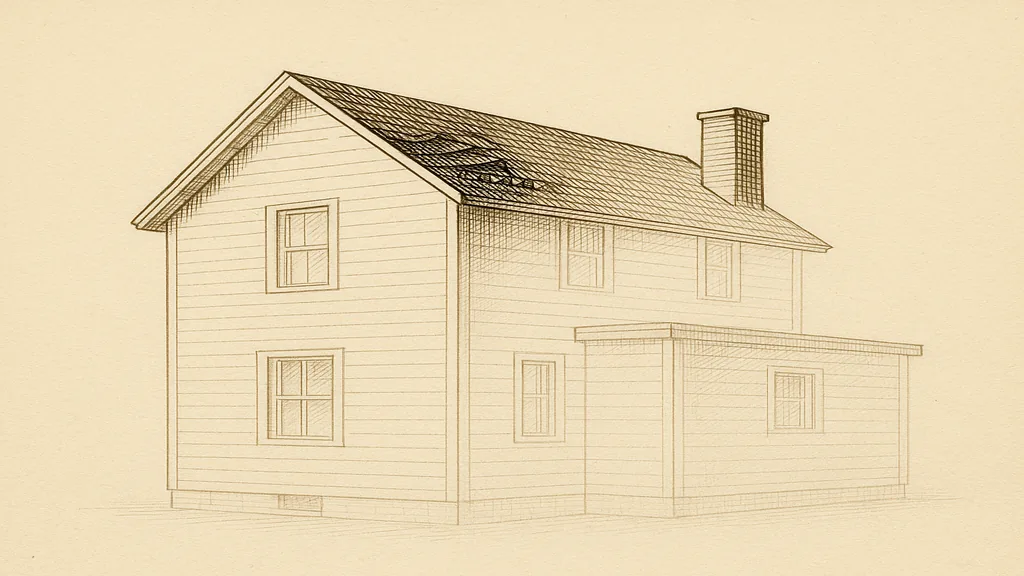
Detached Semi-detached Attached Two-family Low-slope rear extension Party-wall parapet
Every chip is filled because this page turns on the transaction rather than on the shape of the roof: General Business Law § 771-b is written to a roofing contractor and an owner, and covers roofing, gutter, downspout or siding services.
Key figures
- Advertising or promising to pay or rebate an insurance deductible
- Prohibited as an inducement, in any form
- § 771-b(2) NY General Business Law, enacted 2019, effective 2020 VERBATIM [GBL 771-b]
- Reporting, adjusting or negotiating the claim for the owner
- Prohibited to the roofing contractor, and no fee for referring it out
- § 771-b(8) NY General Business Law, enacted 2019, effective 2020 VERBATIM [GBL 771-b]
- Written contract between roofing contractor and owner
- Required every contractor, every owner
- § 771-b(1) NY General Business Law, enacted 2019, effective 2020 VERBATIM [GBL 771-b]
- Cancellation after the insurer writes that part of the claim is not covered
- 3 business days running from that written notice, not from signing
- § 771-b(3) NY General Business Law, enacted 2019, effective 2020 VERBATIM [GBL 771-b]
- Licence to negotiate or settle a property claim for an insured
- Public adjuster where it is done for money, commission or anything of value
- § 2108 NY Insurance Law, read with DFS OGC Opinion 11-08-03 (2011) VERBATIM [INS 2108]
- Insurance fraud in the third degree
- over $3,000 class D felony; the fifth degree has no threshold at all
- § 176.20 NY Penal Law article 176, text retrieved 2026-08-05 REPORTED · YPDCRIME [PL 176]
The statute prohibits the offer, not only the payment
Most national storm-chaser writing stops at "waiving a deductible is insurance fraud," with no section number attached. New York does not need the fraud statute to reach the sentence spoken in a driveway. Section 771-b was added to the New York General Business Law by the 2019 bill known as the storm-chaser bill, signed in November 2019 and effective 180 days later, and it is written to roofing contractors alone — it governs roofing, gutter, downspout and siding services.[GBL 771-b]
“A roofing contractor shall not advertise or promise to pay or rebate all or any portion of any insurance deductible,” including “any allowance or offering any discount … paying the insured … any form of compensation.”
The verb that carries the weight is advertise. The flyer, the yard sign, the text message and the sentence at the door are each independently reachable, whether or not any invoice is ever submitted to an insurer and whether or not the homeowner accepts. A reader who has been handed something in writing that says the deductible will be covered, absorbed, eaten, waived, discounted or credited is holding a document that describes conduct the statute names.
The arithmetic explains why the offer cannot be a discount
An insurer's payment is calculated as the loss less the deductible, on the premise that the deductible portion is paid by the insured. There are only two ways for a contractor to absorb it: the price stated to the insurer overstates the job, or the homeowner is paid back through some other instrument — a referral fee, an advertising fee, a sign in the yard. Both paths put a false statement of material fact in front of an insurer, and the homeowner who signed the paperwork is a participant in it rather than a bystander.
New York grades that conduct by the amount involved. Article 176 of the New York Penal Law sets no threshold at all for the fifth degree, and the third-degree line at $3,000[PL 176] sits below the price of an ordinary roof.
| Section | Degree | Threshold | Class |
|---|---|---|---|
| § 176.05 | Defines the fraudulent insurance act | not applicable: definition section | not applicable: definition section |
| § 176.10 | Fifth | none | Class A misdemeanor |
| § 176.15 | Fourth | over $1,000 | Class E felony |
| § 176.20 | Third | over $3,000 | Class D felony |
| § 176.25 | Second | over $50,000 | Class C felony |
| § 176.30 | First | over $1,000,000 | Class B felony |
| Degrees and thresholds as published on nysenate.gov and in the ypdcrime.com summary of article 176, retrieved 2026-08-05 REPORTED · YPDCRIME. Bills in the 2025–26 session would lower the second- and first-degree thresholds; their status was not confirmed and they are not treated here as law. | |||
Handling the claim is barred to the roofing contractor twice over
An offer to deal with the insurance company on the owner's behalf describes work that section 771-b removes from a roofing contractor entirely.
A roofing contractor shall not perform “the reporting, adjusting, or negotiating a claim on behalf of the owner and shall not receive compensation for the referral to any entity” doing so.
The second bar is older and broader. Section 2108 of the New York Insurance Law requires a public adjuster licence to act on an insured's behalf in negotiating or effecting the settlement of a property claim, and the Department of Financial Services stated the point directly in Office of General Counsel Opinion 11-08-03 (2011): the licence is required where a person, “for money, commission or any other thing of value, acts or aids in any manner on behalf of an insured in negotiating for, or effecting, the settlement of a claim or claims for loss or damage to property.”[DFS OGC 11-08-03] The same opinion adds that such a person may also be practising law without a licence, and names the penalties: up to $500 per transaction under Insurance Law § 2102(g), and, under § 109(a), a violation of the Insurance Law is a misdemeanor unless it is a felony.
The lawful route exists and it is a different person. A public adjuster licensed by the Department of Financial Services may negotiate a claim; the contractor who wants the repair work may not.
The clock that matters after a partial denial does not start when you sign
Four separate three-business-day cancellation rights can attach to the same roofing job, and they start at different moments. The one written for insurance work is the one nobody mentions, because it does not begin until the insurer puts a refusal in writing.
| Right | The clock starts | Source |
|---|---|---|
| Home improvement contract, New York State | On signing; the notice of the right is a required contract term | GBL § 771(1)(e) [GBL 771] |
| Home improvement contract, New York City | On signing, or on receiving the written notice of the right to cancel, whichever is later; waivable only by a separate dated handwritten signed statement for an owner-initiated emergency | AC § 20-394.1 [AC 20-394.1] |
| Door-to-door sale, New York State | On the sale; the notice must be in not less than 10-point bold face type and a refund is due within 10 business days | PPL §§ 427, 428 [PPL 427] |
| Sale away from the seller's permanent place of business, federal | On the sale, where the price is over $25 at the buyer's home or over $130 at a temporary location | 16 CFR part 429 [16 CFR 429] |
| Roofing contract tied to an insurance claim | When the insured receives the insurer's written notice that all or any part of the claim is not a covered loss | GBL § 771-b(3) [GBL 771-b] |
| The door-to-door right is in the Personal Property Law, not the General Business Law. General Business Law § 425, cited for this proposition in a good deal of circulating material, is a coin-processor insurance statute. | ||
The practical shape of § 771-b(3) is that a contract signed on the strength of a claim that is later refused in part can be cancelled after the refusal arrives — weeks or months after every other clock has run out. That is the provision to look for in the paperwork before signing anything while a claim is open.
New York City adds prohibitions that reach the close itself
Section 20-393 of the New York City Administrative Code lists prohibited acts for a home improvement contractor. Item (16) bars a gift, bonus, award, merchandise, trading stamps or a cash loan as an inducement to a contract; an advertising trinket is permitted only if it is not conditioned on getting the contract, costs no more than $2.50 and is one per transaction.[AC 20-393] The television-if-you-sign-tonight close is not a grey area in this city. The Department of Consumer and Worker Protection also states in its own consumer guidance that home improvement contractors are not allowed to arrange or offer financing for a home improvement loan.[DCWP]
Underneath all of it sits the licence. Residential home improvement work over $200 in New York City requires a Home Improvement Contractor licence from the Department of Consumer and Worker Protection, under Administrative Code § 20-387(a).[AC 20-387] The licence is a consumer-protection registration with a bond or trust-fund requirement — it is not a test of roofing skill, and New York State has no roofing competency licence at all. How to confirm one exists is set out at Checking a contractor.
A claim is not a condition report, and the repair is not automatically the whole roof
The party who writes the scope of a storm claim is very often the party paid by its size. That is the structural reason a knock-on-the-door inspection tends to resolve to a full replacement, and it is worth separating two questions that arrive together: what the roof needs, and what the claim will pay for.
Repair is a lawful and ordinary answer here. Roof repair and reroofing above the deck — membrane, coverings, cant strip and insulation above the sheathing — is listed at Table 2, IV.1 of 1 RCNY § 101-14 as requiring no Department of Buildings permit, provided the New York City Energy Conservation Code does not require additional thermal insulation; work that includes replacing the deck or sheathing is item IV.2 and does require one.[1 RCNY 101-14] A lifted course, a strip of missing tabs and damaged flashing are repairs before they are anything else. What the code forbids laying over an existing roof, and when replacement is the only compliant answer, is a separate question set out at when the code forbids shingling over an existing roof.
The state's own consumer guidance frames the arrival rather than the roof. The Division of Consumer Protection at the New York Department of State puts it in one sentence — “Most good contractors are too busy to seek business at your front door” — and names the offer of leftover materials from a job down the block as a recognised pitch.[DOS]
A free roof was the hook in the most recent New York action
On the New York Attorney General filed suit against Attyx LLC, formerly SUNco, its two chief executives, and the lenders Solar Mosaic and WebBank. The complaint alleges that consumers were promised free roof replacements funded by government incentives or solar tax credits, that no government programs providing consumers with free roofs existed, and that the cost of the roof was built into an inflated solar price financed by a long-term loan; the Attorney General's office estimates the conduct generated roughly $275 million in New York.[NYAG ATTYX] Those are allegations in a filed complaint and nothing here treats them as findings. The pattern is the durable part: the roof is free because it is being paid for somewhere the homeowner is not looking.
What this page does not cover
This page is about what a roofing contractor may and may not offer, advertise or do with an insurance claim in New York. It is not about whether a particular loss is covered, what a particular policy says, or what a claim is worth. It does not interpret anyone's declarations page, and it takes no position on any specific contract, contractor or claim.
Deciding whether a roof needs repair or replacement is a question about the roof, and the answer is in the construction code and in the condition of the assembly, not in this page. Where the deck or sheathing is being replaced, a Department of Buildings permit is required under Table 2, IV.2 of 1 RCNY § 101-14, and structural questions about a roof belong to a New York registered architect or licensed professional engineer. A claim dispute that requires someone to negotiate with an insurer belongs to a public adjuster licensed by the Department of Financial Services or to a lawyer — under New York Insurance Law § 2108 it does not belong to the roofer.
What this page does not establish
- Which subsection of General Business Law § 771-b carries the rule that a roofing contractor may not require a deposit. The provision was read from the statute text, but the subsections independently confirmed here are (1), (2), (3) and (8), and (1) is the written-contract requirement. Reading the codified statute section by section would settle it; until then no subsection is cited for the deposit rule.
- Whether New York property policies contain anti-assignment clauses and whether New York courts enforce an assignment of insurance benefits made after a loss. This was not researched, and the litigation record that exists in other states does not establish New York law. Pulling New York policy forms and reported decisions would settle it.
- The status of the 2025–26 bills that would lower the second-degree insurance fraud threshold from $50,000 and the first-degree threshold from $1,000,000. Checking the legislature's own bill status would settle it; the thresholds printed above are the ones in the article 176 text retrieved on 2026-08-05.
- Whether a homeowner can recover money already paid to an unlicensed contractor. The established rule runs the other way — an unlicensed contractor cannot sue to collect — and recovery of money already handed over is fact-specific. No source opened here settles it.
- Whether a homeowner can look up a Home Improvement Salesperson licence, which is the credential the person knocking at the door is most likely to need. The Department of Consumer and Worker Protection checklist URL for that licence returns a 404 and the open licensing dataset returns no records in that category. A working lookup, or a statement from the agency that none exists, would settle it.
- Whether, and in what terms, New York requires a licensed public adjuster to disclose in writing a financial interest in a contracting or repair business. 11 NYCRR Part 25 (Regulation 10) is the rule named in the research, but the operative subsection was not confirmed, so no requirement is stated here. Opening the codified rule would settle it.
Sources
- [GBL 771-b]
- New York State Senate. New York General Business Law § 771-b — Roofing contractors, article 36-A. Enacted 2019, effective 180 days after signing. Subsections (1), (2), (3) and (8) confirmed against the Senate text. nysenate.gov · Retrieved 2026-08-05
- [GBL 771]
- New York State Senate. New York General Business Law § 771 — Home improvement contracts, article 36-A, § 771(1)(e) (notice of the right to cancel until midnight of the third business day after signing). nysenate.gov · Retrieved 2026-08-05
- [PL 176]
- New York State Senate. New York Penal Law, article 176 — Insurance Fraud, §§ 176.05–176.30. Degree and threshold summary cross-read against the ypdcrime.com rendering of article 176. nysenate.gov · ypdcrime.com · Retrieved 2026-08-05
- [INS 2108]
- New York State Senate. New York Insurance Law § 2108 — Adjusters. nysenate.gov · Retrieved 2026-08-05
- [DFS OGC 11-08-03]
- New York State Department of Financial Services, Office of General Counsel. Opinion 11-08-03 (2011), on when a public adjuster licence is required and on the penalties at Insurance Law § 2102(g) and § 109(a). dfs.ny.gov · Retrieved 2026-08-05
- [AC 20-387]
- New York City Administrative Code, title 20, subchapter 22, § 20-387(a) — Licence required; § 20-397(5) for the $200 threshold and its anti-evasion clause. Read on a public mirror of the Administrative Code; numbering cross-checked before quotation. nycadmincode mirror · Retrieved 2026-08-05
- [AC 20-393]
- New York City Administrative Code, title 20, § 20-393 — Prohibited acts, item (16)(b)–(c) (no gift, bonus, award, merchandise, trading stamps or cash loan as an inducement; advertising trinkets unconditional, no more than $2.50, one per transaction). Same mirror as above. nycadmincode mirror · Retrieved 2026-08-05
- [AC 20-394.1]
- New York City Administrative Code, title 20, § 20-394.1 — Notice of cancellation (third business day after signing or after receipt of the notice, whichever is later; emergency waiver by separate dated handwritten signed statement). Same mirror as above. nycadmincode mirror · Retrieved 2026-08-05
- [DCWP]
- New York City Department of Consumer and Worker Protection. Home Improvement Contractor Tips, rev. 06/2026 (deposit guidance; the statement that contractors may not arrange or offer financing for a home improvement loan). nyc.gov PDF · Retrieved 2026-08-05
- [PPL 427]
- New York State Senate. New York Personal Property Law, article 10-A — Door-to-Door Sales Protection Act, § 427 (cancellation until midnight of the third business day) and § 428 (notice in not less than 10-point bold face type; refund within 10 business days). nysenate.gov § 427 · § 428 · Retrieved 2026-08-05
- [16 CFR 429]
- United States Federal Trade Commission. Rule Concerning Cooling-Off Period for Sales Made at Homes or at Certain Other Locations, 16 CFR part 429 (over $25 at the buyer's home; over $130 at a temporary location). ecfr.gov · Retrieved 2026-08-05
- [NYAG ATTYX]
- Office of the New York State Attorney General. Attorney General James Sues Home Solar Power Company and Lenders for Cheating New Yorkers, and the filed complaint in New York v. Attyx LLC, 2026-03-17. Allegations, not findings. ag.ny.gov · complaint PDF · Retrieved 2026-08-05
- [DOS]
- New York State Department of State, Division of Consumer Protection. Consumer Alert: Division of Consumer Protection Provides New Yorkers Tips (door-knock solicitation; the leftover-materials pitch). dos.ny.gov · Retrieved 2026-08-05
- [1 RCNY 101-14]
- New York City Department of Buildings. 1 RCNY § 101-14 — Minor Alterations and Ordinary Repairs, Table 2, items IV.1 and IV.2. Original rule effective 2011-10-02. nyc.gov PDF · Retrieved 2026-08-05