A DOB permit is triggered by the deck, not by a percentage of the roof
The rule that decides whether a New York City roof job needs a Department of Buildings permit turns on a single question — whether any part of the deck beneath the covering is being replaced — and it contains no percentage of roof area anywhere in it.
Richmond County Roofing is an independent reference work. It is not a contractor, it sells and installs nothing, it performs no inspections, and nobody associated with it has installed a roof or hired a roofer. Nothing on this page is a determination about any particular building: whether a specific job is exempt is decided by the Department of Buildings against the work actually performed, not here. The permit rule quoted below is 1 RCNY § 101-14 as amended effective 2026-06-10; the code sections are from the 2022 New York City Construction Codes, in force since November 7, 2022.
- Detached
- Semi-detached
- Attached
- Two-family
- Low-slope rear extension
- Party-wall parapet
Key figures
- Reroofing above the deck or sheathing
- No permit membrane, coverings, cant strip, insulation above the deck
- 1 RCNY § 101-14, Table 2, IV.1 1 RCNY, amendment eff. 2026-06-10 VERBATIM [1 RCNY 101-14]
- Reroofing that includes the deck or sheathing
- Permit required any replacement of roof deck/sheathing
- 1 RCNY § 101-14, Table 2, IV.2 1 RCNY, amendment eff. 2026-06-10 VERBATIM [1 RCNY 101-14]
- Replacement in kind of exterior gutters and leaders
- No permit in kind — like for like
- 1 RCNY § 101-14, Table 3, IX.2 1 RCNY, amendment eff. 2026-06-10 VERBATIM [1 RCNY 101-14]
- The one roof-area percentage in the reroofing rules
- 50% and under 500 sq ft — the threshold for reflective surfacing, not for a permit
- § 1511.1 Exception 1 2022 NYC Building Code VERBATIM [BC 1511.1]
- Penalty for permit-required work done without one, one- or two-family dwelling
- 6 × the fee not less than $600, not more than $10,000
- AC § 28-213.1.1 2022 NYC Construction Codes, Admin. Code Ch. 2 VERBATIM [AC 28-213]
 1
2
3
1
2
3
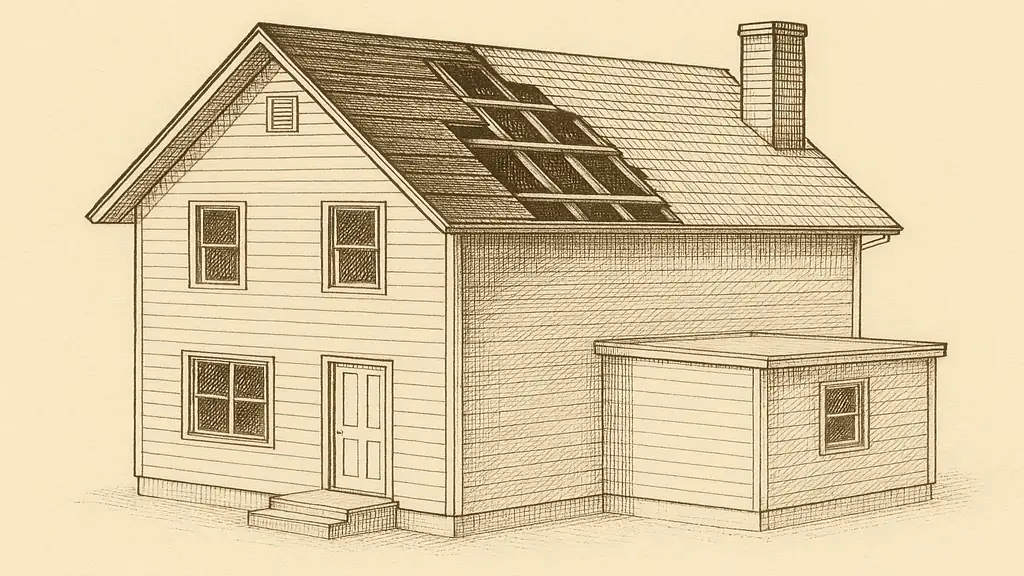
- The roof covering — shingles, underlayment, and on a low-slope plane the membrane and any insulation above the deck. Work confined to this layer is 1 RCNY § 101-14, Table 2, IV.1
- The deck, also called the sheathing — the boards or plywood the covering is fastened to. Replacing any of it is 1 RCNY § 101-14, Table 2, IV.2
- The rafters — roof construction. Removing or cutting away any portion of it is expressly not an ordinary repair, AC § 28-105.4.2.1, 2022 NYC Construction Codes
The rule that decides this is a Department of Buildings rule, not the Building Code
Section 28-105.4 of the Administrative Code, in the 2022 New York City Construction Codes, exempts from a permit "Other categories of work as described in department rules, consistent with public safety"[AC 28-105.4] — the hook the Department of Buildings hangs its own rule on. That rule is 1 RCNY § 101-14, "Categories of work that may or may not require a permit," effective 2011-10-02 and last amended effective 2026-06-10, an amendment that corrected a cross-reference and changed an unrelated gas-piping rule and left the roofing rows untouched.[1 RCNY 101-14 PROM] Roof work is Table 2, Category IV, and two of its three rows decide almost every reroof on a one- or two-family house.
IV.1 — "Roof repair and reroofing above the deck/sheathing. Roof repair or replacement, limited to the roof membrane, roof coverings, cant strip, and any insulation above the roof deck/sheathing, provided that the New York City Energy Conservation Code does not require additional thermal insulation for the roof." Permit required: No.
IV.2 — "Roof repair and reroofing, including the deck/sheathing. Roof repair or replacement that includes replacement of roof deck/sheathing." Permit required: Yes.
Neither row mentions an area, a fraction or a percentage. The third row, IV.3, exempts green roof systems not more than 4 inches deep, but only on buildings of noncombustible construction or over 100 feet in height, so it does not reach a wood-framed house.[1 RCNY 101-14] Note the condition inside IV.1: the exemption holds only "provided that the New York City Energy Conservation Code does not require additional thermal insulation for the roof." Where insulation must be added, that condition fails and the row's exemption is not available. Which section of the energy code imposes it, and which edition is in force, are not established here, so no number for it is printed.
Replacing any part of the deck is not an ordinary repair, and that is the whole trigger
Section 28-105.4.2 states that "A permit shall not be required for minor alterations and ordinary repairs," and § 28-105.4.2.1 defines an ordinary repair as a replacement or renewal of existing work "with the same or equivalent materials or equipment parts… that do not in any way affect health or the fire or structural safety of the building." The same section then lists the work that is not one.
"The removal or cutting away of any load bearing or required fire rated wall, fire door, floor, or roof construction, or any portion thereof."
"Or any portion thereof" is why the trigger has no size, and item 8 of the same list adds "any other work affecting health or the fire or structural safety of the building."[AC 28-105.4] The test that can be applied to a written scope of work has two branches and no arithmetic in either. Work confined to what sits above the plywood or plank sheathing falls in Table 2, IV.1 and needs no permit. Work that replaces even part of that sheathing falls in Table 2, IV.2 and does.
| Work as it is usually written on an estimate | Rule row | DOB permit | What still has to be checked |
|---|---|---|---|
| Strip all shingles to the sheathing, new underlayment, new shingles | Table 2, IV.1 | No | The energy-code condition written into IV.1 itself |
| Replace eight sheets of plywood found rotten | Table 2, IV.2 | Yes | AC § 28-105.4.2.1, item 1 — roof construction, any portion |
| New membrane over the existing low-slope covering | Table 2, IV.1 | No | Whether a recover is permitted at all — § 1511.3.1.1, 2022 NYC Building Code |
| Replace gutters and leaders with the same | Table 3, IX.2 | No | "Replacement in kind" — a change of material is not in kind |
| Green roof tray system, 4 inches deep, on the rear extension | Table 2, IV.3 | Not exempt here | That row reaches only noncombustible construction or buildings over 100 ft |
| Rows describe the rule's categories, not a classification of any actual job. Section 101-14(a) says these categories "may" be classified as ordinary repairs and that the tables are "not an exclusive list." | |||
There is no 25 percent rule, and the percentage that does exist governs a reflective surface
A Staten Island roofing company's frequently-asked-questions page states that projects replacing or repairing more than 25 percent of the roof surface require a permit from the Department of Buildings. No such threshold appears in 1 RCNY § 101-14: Category IV of Table 2 and Category IX of Table 3 are the rule's only roofing rows, both are reproduced above, and neither contains a percentage of roof area.[1 RCNY 101-14]
2022 ED. · CH. 15 AMENDED LL77/2023 The nearest figure of that shape belongs to a different rule with a different consequence. Section 1511.1 Exception 1 of the 2022 New York City Building Code provides that § 1504.9 does not apply where the area recovered or replaced is less than 50 percent of the roof area and less than 500 square feet (46.5 m²).[BC 1511.1] Section 1504.9 is the reflective-surfacing requirement: at a slope of 2:12 or less, an initial solar reflectance of 0.7 and a thermal emittance of 0.75, or a Solar Reflectance Index of 82.[BC 1504.9] Both conditions must hold, not either one, and what the threshold decides is whether a low-slope reroof has to be white. It decides nothing about a permit.
"No DOB permit" does not mean "no paperwork"
The rule says so itself, in subsection (c).
"Any exemptions outlined by this rule will not grant authorization for any work to be done in a manner that violates the provisions of this code, the New York City Energy Conservation Code, the Zoning Resolution or any other laws, rules, or regulations. Such exemptions shall not eliminate the obligation of any owner to file at other City agencies, when appropriate, including but not limited to the Landmarks Preservation Commission, the City Planning Commission, Department of Transportation, Department of Environmental Protection, Department of Environmental Conservation, or the Fire Department, nor shall it eliminate the obligation of any owner to file at the Department of Buildings for any related work, such as, for example, associated sidewalk protection, structural work, electrical connections, or plumbing connections."
Two of those agencies attach to ordinary roof work on an ordinary house. The Fire Department appears because torch-applied roofing carries its own permit and its own certificates of fitness, which the Buildings exemption does not touch — the subject of FDNY's published position on torch-applied roofing over combustible construction. The Department of Environmental Protection appears because of asbestos, and whether the owner's survey duty reaches a reroof that needs no Buildings permit is not established here; no sentence on this page answers it in either direction.
The penalty for skipping a required permit is billed to the owner and follows the building
Where a permit was required and not obtained, Article 213 of the Administrative Code sets the consequence, and the department maintains a public watch list of contractors found to have performed work without a required permit in the preceding two years (§§ 28-213.5, 28-213.5.1).[AC 28-213] Where a permit was obtained, two mechanics are checkable from the street: it "shall be posted in a conspicuous place at the work site, visible to the public for the duration of the work" (§ 28-105.11), and it "shall expire by operation of law if the insurance upon which the permit was conditioned lapses, expires or is cancelled" (§ 28-105.12.7).[AC 28-105.5]
| Item | Figure | Source |
|---|---|---|
| Penalty, work without a required permit, one- or two-family dwelling | 6 × the permit fee, minimum $600, maximum $10,000 | AC § 28-213.1.1 VERBATIM |
| Who pays, and what follows | The owner of the building; no further permit issues at that address until it is paid; every other departmental civil penalty there is doubled for a year | AC §§ 28-213.2, 28-213.3, 28-213.6 VERBATIM |
| Department of Buildings alteration permit fee, one- or two-family dwelling | no figure: no primary source opened | Three incompatible per-$1,000 rates appear in the sources consulted; the current published fee schedule has not been opened. |
| The cell marked —— is left empty rather than filled from secondary reporting. The penalty rows do not depend on it: the floor and the cap are stated in the section itself. | ||
A repair that stays above the deck is still governed by Chapter 15, and the deck line is checkable
The exemption exempts the filing, never the code. A patch to one plane, a reconstructed valley or a replaced run of gutter can all be permit-exempt and all remain subject to Chapter 15 of the 2022 New York City Building Code. Section 1511.1.1 is one sentence: "Reroofs shall provide positive drainage." Section 1511.5 provides that existing vent flashing, metal edgings, drain outlets, collars and metal counterflashings "shall not be reinstalled where rusted, damaged or deteriorated," and § 1511.6 that flashings "shall be reconstructed."[BC 1511] Reusing tired flashing on a permit-exempt repair is not merely a shortcut; where the metal is deteriorated it does not comply. A repair confined to the covering is the cheaper branch and is frequently the compliant one — the limits on going over an existing roof are the subject of when the code forbids shingling over an existing roof.
Because deck replacement is a priced line and a permit trigger at once, an estimate and a permit record are checkable against each other. If sheathing appears in the scope of work, the job is in Table 2, IV.2 and a filing should exist. Ask for the per-sheet unit price in writing before work starts, and for photographs of any sheet claimed to be rotten. A filing sits in one of two systems and both need checking: the Buildings Information System holds permits and job applications created before DOB NOW launched, the DOB NOW Public Portal holds applications submitted in DOB NOW, and Staten Island is Borough 5, Richmond.[DOB BUILDING DATA] The converse inference does not hold: a roofer absent from those systems may simply have done permit-exempt work, which generates no record at all. The place to check a home improvement contractor is the Department of Consumer and Worker Protection, set out at how to check a contractor and a contract.
What this page does not cover
This page reads Category IV — Roofs — of Table 2 of 1 RCNY § 101-14 plus the one gutters-and-leaders row of Table 3; parapet, coping and other façade work sits outside it. It does not cover the Landmarks Preservation Commission's separate approvals, which survive the Buildings exemption under § 101-14(c). It states no permit fee, and it names no Department of Buildings contractor registration, because the department's guidance page and the Chapter 4 definition of general contractor point in different directions for an alteration to an existing house. It classifies no actual job.
On the sources read here a Department of Buildings filing is required whenever the job replaces any part of the roof deck or sheathing (Table 2, IV.2), and separately for related work such as sidewalk protection, structural work, electrical connections or plumbing connections (§ 101-14(c)). Where the entire existing roof deck or assembly is replaced a further requirement attaches to that filing — see replacing a roof covering does not trigger the sustainable roofing zone. Structural adequacy is determined by a New York State registered design professional.
What this page does not establish
- The current Department of Buildings alteration permit fee for a one- or two-family dwelling. Three incompatible per-$1,000 rates appear in the sources consulted, and the statutory table states that its rates "shall be subject to increases as provided by department rules." Opening the department's current published fee schedule would settle it. The penalty at AC § 28-213.1.1 is therefore quoted only as a multiple with its own stated floor and cap.
- Which section of the New York City Energy Conservation Code triggers the proviso inside 1 RCNY § 101-14, Table 2, IV.1, and which edition of that code is in force. The subsection was read only from a secondary renderer. Opening a nyc.gov or New York State Department of State PDF of the operative edition would settle it; the proviso itself is quoted from the permit rule, which was opened.
- Whether the owner's asbestos-survey duty under the Department of Environmental Protection's rules reaches a reroof that requires no Department of Buildings permit. AC § 28-106.1 gates the permit on asbestos certification, the survey duty is written to the work, and 1 RCNY § 101-14(c) preserves that department's obligation notwithstanding a Buildings exemption. A determination from that department would settle it. Neither answer is published here.
Sources
- [1 RCNY 101-14]
- New York City Department of Buildings. 1 RCNY § 101-14, Categories of work that may or may not require a permit. Table 2, Category IV (Roofs), rows IV.1, IV.2 and IV.3; Table 3, Category IX, row 2; subsections (a) and (c). Applies to work in New York City. nyc.gov PDF Retrieved 2026-08-06.
- [1 RCNY 101-14 PROM]
- New York City Department of Buildings. 1 RCNY § 101-14 — promulgation details and dates. Original rule effective 2011-10-02; most recent amendment effective 2026-06-10, with its statement of basis and purpose. nyc.gov PDF Retrieved 2026-08-06.
- [AC 28-105.4] · [AC 28-105.5]
- New York City. 2022 New York City Construction Codes, Administrative Code Chapter 1 — General Administrative Provisions, §§ 28-105.4, 28-105.4.2, 28-105.4.2.1, 28-105.11, 28-105.12.7. Construction codes effective 2022-11-07. nyc.gov PDF
- [AC 28-213]
- New York City. 2022 New York City Construction Codes, Administrative Code Chapter 2 — Enforcement, Article 213, §§ 28-213.1.1, 28-213.2, 28-213.3, 28-213.5, 28-213.5.1, 28-213.6. nyc.gov PDF
- [BC 1511] · [BC 1511.1]
- New York City Department of Buildings. 2022 New York City Building Code, Chapter 15 — Roof Assemblies and Rooftop Structures, as amended by Local Law 77 of 2023 (eff. 2023-06-10). §§ 1511.1 Exception 1, 1511.1.1, 1511.3.1.1, 1511.5, 1511.6. nyc.gov PDF
- [BC 1504.9]
- New York City Department of Buildings. 2022 New York City Building Code, Chapter 15 — Roof Assemblies and Rooftop Structures, § 1504.9, reflective surfacing for roofs with a slope of 2:12 or less. nyc.gov PDF
- [DOB BUILDING DATA]
- New York City Department of Buildings. Find Building Data, describing the split between the Buildings Information System and the DOB NOW Public Portal. Staten Island is Borough 5, Richmond. nyc.gov Retrieved 2026-08-06.