What is known about roof cost here, and how to read the estimate you were handed
No agency publishes what a roof costs on Staten Island; what is published is a producer price index for shingle material, a workers' compensation loss cost for roofing labour, and a model estimate form the City prints itself — and those, rather than an average, are what a number in your hand can be tested against.
This is an independent reference. It is not a contractor, it sells nothing, and it refers no one. There is no calculator on this page and no price is estimated for any roof; nothing here is an inspection or a determination about your building, and no one associated with it has installed a roof, hired a roofer or paid for a reroof. Where a construction-code section is named it is the 2022 New York City Construction Codes, effective November 7, 2022, together with the Department of Buildings rule 1 RCNY § 101-14. Every figure below carries the document it came from and the date it was retrieved.
Applies to
Detached Semi-detached Attached Two-family Low-slope rear extension Party-wall parapet
Every chip is filled because the documents on this page govern the paperwork rather than the shape of the roof. The geometry underneath the paperwork is not the same: a low-slope rear extension and a party-wall parapet are separate assemblies with separate materials, and an estimate that prices a house as one number has priced them invisibly.
Key figures
- Producer price index, asphalt shingle and coating materials manufacturing
- +46.2% June 2020 to June 2026, index 252.800 to 369.692
- Series PCU324122324122 US Bureau of Labor Statistics, via FRED, retrieved 2026-08-05 DERIVED [BLS PPI]
369.692 ÷ 252.800 − 1 = 0.462
- Producer price index, prepared asphalt, tar roofing and siding products
- +49.6% same window, index 245.700 to 367.585
- Series WPU1361 US Bureau of Labor Statistics, via FRED, retrieved 2026-08-05 DERIVED [BLS PPI]
367.585 ÷ 245.700 − 1 = 0.496
- Workers' compensation loss cost, residential sloped-roof roofing, class 5545
- $12.024 per $100 of payroll — a loss cost, which is not a premium rate
- Filing R.C. 2633 NY Compensation Insurance Rating Board, 2025-07-15, loss costs effective 2025-10-01 VERBATIM [NYCIRB]
- Reroofing that includes the deck or sheathing
- Permit: YES reroofing above the deck only is item IV.1 and requires none
- 1 RCNY § 101-14, Table 2, IV.2 NYC Department of Buildings rule, effective 2011-10-02 VERBATIM [1 RCNY 101-14]
- Civil penalty for work done without a required permit, one- or two-family dwelling
- 6× the fee not less than $600, not more than $10,000, and the owner pays
- § 28-213.1.1 2022 New York City Construction Codes, Administrative Provisions VERBATIM [AC 28-213]
- Home Improvement Contractor licence number on the estimate
- Every page with initials of both parties on every page
- Model Estimate form NYC Dept. of Consumer and Worker Protection, retrieved 2026-08-05 VERBATIM [DCWP EST]
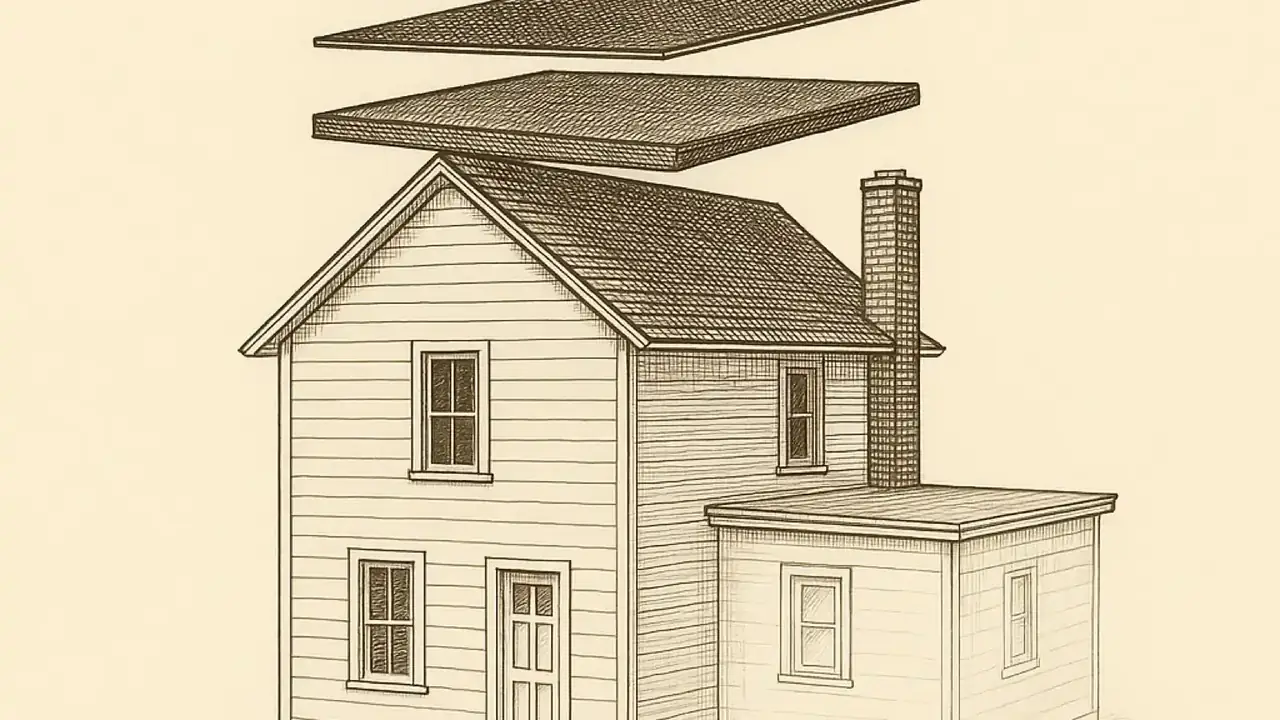
A price means nothing until the job it prices is written down
The question this page exists for is whether a number is sane, and the number cannot be tested without the job. Two estimates for the same house are not comparable, and no published average is comparable to either, unless the following are fixed in writing first: the roof area in squares, one square being 100 square feet of roof surface rather than of floor area; the pitch of each plane; how many existing layers of covering are being removed and from which planes; whether the low-slope rear extension is included and in what material; what happens to the deck if boards are found rotten, and at what unit price; which underlayment product and which ice-barrier membrane, and how far each runs; whether flashings, drip edge, valley metal and pipe boots are new or reused; what ventilation is installed; and who removes the debris.
The housing this is being priced against is unusually uniform. In Richmond County 82.2% of housing units are in one- or two-family structures and 25.5% are one-unit attached, with a median year built of 1974.[ACS 2024] A house of that vintage is being reroofed for the third or fourth time, which means the layer count and the condition of the deck — the two variables that move a price most — are the two the estimate is least likely to state.
The only government-collected series in this market measures material, not roofs
There is no federal or state price series for an installed residential roof. There is one for what the material costs at the factory gate, and it is the spine of every honest statement about why a 2026 quote does not resemble a neighbour's 2019 quote. The Bureau of Labor Statistics producer price index for asphalt shingle and coating materials manufacturing, series PCU324122324122, ran from 252.800 in June 2020 to 369.692 in June 2026.[BLS PPI]
| Month | Index | Change from June 2020 |
|---|---|---|
| December 2019 | 254.300 | — |
| June 2020 | 252.800 | — |
| June 2021 | 280.800 | +11.1% |
| June 2022 | 332.984 | +31.7% |
| June 2023 | 344.756 | +36.4% |
| June 2024 | 350.364 | +38.6% |
| June 2025 | 360.092 | +42.4% |
| June 2026 | 369.692 | +46.2% |
| Index values are the published series VERBATIM; the percentage column is arithmetic on them DERIVED, each cell being the month's index divided by 252.800, less one. The twelve months from June 2021 to June 2022 alone are +18.6%. The companion commodity series WPU1361, prepared asphalt, tar roofing and siding products, moved 245.700 to 367.585 over the same window, +49.6%. | ||
What the series measures is the price producers receive for shingle and coating materials, nationally. It is not an installed price, it is not Staten Island, and it covers neither labour nor the metal, fasteners, membrane and disposal that make up the rest of a job. What it establishes is narrow and useful: a homeowner comparing a quote to a remembered figure from six years ago is comparing across a material-cost increase of roughly 46% to 50% before any other line has changed.
The two figures published as this market's average differ by about two times
Searching for a Staten Island roof price returns averages. Each of them comes from a company that sells leads, sells roofing, or takes a fee on roofing payments, and none publishes a methodology, a sample or a job specification. They are printed here together because the disagreement between them is the most informative thing about them.
New York prices roofing labour through the most expensive trade class in the state
The part of the price that is genuinely local is not the shingle. The New York Compensation Insurance Rating Board files loss costs by class code with the Department of Financial Services; filing R.C. 2633, dated with loss costs effective , sets class 5545, residential sloped-roof roofing, at $12.024 per $100 of payroll, against $6.939 for class 5538, $4.882 for 5547 and $3.900 for 5536.[NYCIRB] The same filing lowered the overall New York loss cost level by 13.2%, and still leaves roofing the most expensive class among those four.
The Rating Board attaches its own caution to the number, and it has to be carried wherever the number goes.
“The published values … are not rates. Therefore, insurers must apply their approved loss cost multipliers to the loss costs in the Manual to develop final rates.”
So $12.024 is not what a roofer pays; it is the base a carrier multiplies and then adjusts by the employer's experience modification. What it does show is the ordering, and the ordering is the point: putting people on a sloped residential roof in New York is priced as the riskiest of these trades before a single shingle is bought. The same filing's premium-credit wage table for class 5545 begins its credits at an average hourly wage of $36.00, with the ten per cent credit band running $36.00 to $45.13 and a twenty-five per cent credit above $53.64 — a New York wage datum published by a rating body rather than by anyone selling a roof.
Three further costs sit under every compliant price here and under no unlicensed one. A roofing contractor in New York must carry workers' compensation and general liability of $100,000 per person and $300,000 per occurrence for bodily injury, plus $50,000 per occurrence and aggregate for property damage, under General Business Law § 771-b;[GBL 771-b] a contractor licensed or registered with the Department of Buildings must show a commercial general liability policy of $1,000,000 together with workers' compensation and disability coverage, under § 28-401.9 of the 2022 New York City Construction Codes;[AC 28-401.9] and the Department of Consumer and Worker Protection requires every Home Improvement Contractor applicant to post a $20,000 surety bond or pay $200 into the Home Improvement Contractor Trust Fund, on top of a $50 examination fee.[DCWP] Disposal is the fourth: there are no active landfills in the five boroughs, so every ton of tear-off leaves the city on a truck.
The City publishes the form the estimate you were handed should have followed
New York City prints a model Estimate, a model Contract with a Notice of Cancellation, a Change Order form and a Permit Disclosure form, and publishes all four as free PDFs.[DCWP EST][DCWP CON] Reading what is in hand against those forms line by line is the single most useful thing available to a homeowner in this city, because it converts a judgement about a stranger into a comparison between two documents. The model estimate requires the contractor's Home Improvement Contractor licence number printed at the top of every page, the salesperson's name, a description of the work with its estimated cost, a list of any materials the consumer is supplying, a yes-or-no box recording that brands were discussed, which permits are required and who obtains them, and both parties' initials on every page. On warranties its instruction is four words long: if none, state none.
| Line | What it must state | Where the requirement comes from |
|---|---|---|
| Licence number | The DCWP Home Improvement Contractor number, on every page | DCWP model Estimate; licence required for residential work over $200, AC § 20-387(a) [AC 20-387] |
| Materials | Quantity, quality, brand, identifying features and estimated price, itemised, with a subtotal | DCWP model Contract [DCWP CON] |
| Tear-off | How many existing layers come off, and from which planes | Trade scope, not a form requirement; it is the largest single price lever and the code decides when it is compulsory |
| Deck replacement | A unit price per sheet, in writing, before signing | Trade practice; the work itself is the permit trigger at 1 RCNY § 101-14 Table 2, IV.2 [1 RCNY 101-14] |
| Permits | Type, reason, who obtains each, the estimated fee, and how to verify status — disclosed in writing before the contract is signed | DCWP Permit Disclosure form [DCWP PERMIT] |
| Subcontractors | Whether any are used, and an agreement to use only licensed ones; the consumer is not responsible if the contractor fails to pay them | DCWP model Contract [DCWP CON] |
| Workers' compensation | The certificate handed to the consumer before work begins | DCWP model Contract [DCWP CON] |
| Dates | Estimated start and substantial completion, with a written list of contingencies that could move them | DCWP model Contract; GBL § 771 [GBL 771] |
| Payment schedule | Dollar amounts tied to stages of completion, not to calendar dates | GBL § 771 [GBL 771] |
| Change orders | In writing, signed by both parties, before the changed work starts, stating the new total | DCWP model Contract and Change Order form [DCWP CON] |
| Warranties | Terms, conditions and period, for the material and for the workmanship separately — "if none, state none" | DCWP model Estimate [DCWP EST] |
| Cleanup | Named as required labour | DCWP model Contract [DCWP CON] |
| A contractor is separately obliged to disclose that a written estimate of materials and labour is available, and may charge for it only if that is disclosed in advance and itemised in the contract price (AC § 20-395). An estimate that is one line and one number is not a price for any of the rows above; it is a price for whichever of them the contractor later says it included. | ||
A charge for plywood on a job with no permit is a contradiction on the face of the estimate
Table 2 of 1 RCNY § 101-14, the Department of Buildings rule on minor alterations and ordinary repairs, splits reroofing in two. Item IV.1, roof repair and reroofing above the deck or sheathing — membrane, coverings, cant strip and insulation above the deck — requires no Department of Buildings permit, provided the New York City Energy Conservation Code does not require additional thermal insulation. Item IV.2, roof repair and reroofing including the deck or sheathing, requires one.[1 RCNY 101-14]
That produces a test nothing else in the estimate genre offers. If the estimate charges for sheets of plywood, the job as priced is item IV.2 and a permit is required for it; if the same estimate says no permit is needed, the two lines contradict each other and one of them is wrong. The honest resolutions are ordinary — the sheets are contingent and may not be needed, or the permit line was simply left off — but the question has to be asked before signing rather than after, because the penalty for unpermitted work is written to the owner. Section 28-213.1.1 of the 2022 New York City Construction Codes sets it at six times the permit fee, not less than $600 and not more than $10,000 for a one- or two-family dwelling; § 28-213.2 places it on the owner; § 28-213.3 blocks any further permit at that building until it is paid; and § 28-213.6 doubles every other departmental civil penalty at that building for a year.[AC 28-213]
The practical requests that follow are small. Ask for the per-sheet unit price in writing before signing, so that "plywood as needed" is not an open account. Ask for a photograph of each sheet claimed to be rotten, taken before it is removed. And read the Permit Disclosure, which the contractor is required to hand over before the contract is signed, against the permit line in the estimate.[DCWP PERMIT]
| Item | Figure | Note |
|---|---|---|
| Civil penalty for work without a required permit, one- or two-family dwelling | 6 × the fee, floor $600, cap $10,000 | Stated in § 28-213.1.1 of the 2022 New York City Construction Codes. It is a multiple, so it does not depend on the fee rate. |
| DOB alteration permit fee, one- or two-family dwelling | no figure: no primary source opened | Three incompatible per-$1,000 rates appear in the sources consulted, and the fee schedule is subject to increase by departmental rule. The Department of Buildings' current published fee schedule has not been opened, so no figure is printed and no worked example is offered. |
| Cells marked —— had no primary source that this site opened. They are left empty rather than filled from secondary reporting. A contractor's quoted permit charge is a line to ask about, but this page publishes no figure to check it against. | ||
Repair is a priced scope, and it is the one the estimate is least likely to contain
Almost every published answer to "what does a roof cost" is an answer about replacement, because replacement is what the publisher sells. Repair is a real and often lawful alternative, and it is cheaper for a structural reason rather than a rhetorical one: work above the deck is outside the permit line at item IV.1 of 1 RCNY § 101-14, and replacement in kind of exterior gutters and leaders sits at Table 3, IX.2 of the same rule with no permit either.[1 RCNY 101-14] Flashing at a chimney or a wall, a pipe boot, a strip of missing tabs, a valley, a ponding correction on the rear extension and a ventilation upgrade are each a scope that can be written, priced and compared.
The way to make that comparison possible is to ask for the repair scope and the replacement scope as two separate written estimates on the City's model form, rather than as a conversation. Where replacement is genuinely compulsory it is compulsory for a reason with a section number attached — the conditions under which the code forbids covering an existing roof are set out at when the 2022 New York City Building Code forbids shingling over an existing roof — and a contractor who cannot name that reason is making a commercial recommendation, not reporting a rule.
The payment schedule is a contract term, and the deposit is the term most often wrong
General Business Law § 771 requires progress payments to be shown as dollar amounts tied to specific stages of completion, and payments taken before substantial completion are subject to the escrow provisions carried into article 36-A from Lien Law § 71-a(4): the money is held for the owner unless a bond, a contract of indemnity or an irrevocable letter of credit is substituted.[GBL 771] A schedule keyed to dates rather than to stages inverts that: it pays for time instead of for work. How much may be taken at the front of the job is a question on which the two published instruments do not line up.
What this page does not cover
This page does not price a roof. It does not contain an average, a calculator, a range for any material, or a figure that should be applied to a particular house, and it takes no position on whether any specific estimate is high, low or fair. It is a description of the documents that exist and of what each one measures.
It also stops where competence begins. Whether a deck can carry a heavier covering, whether framing is adequate, and what a sagging low-slope extension needs are questions for a New York registered architect or licensed professional engineer, not for an estimate. Where the deck or sheathing is being replaced, a Department of Buildings permit is required under Table 2, IV.2 of 1 RCNY § 101-14, and § 101-14(c) preserves separate filing obligations with other agencies — including the Fire Department, the Department of Environmental Protection and the Landmarks Preservation Commission — whether or not a Buildings permit is needed. Money already lost is a separate route again: New York City small claims stops at $10,000, which is below the price of a roof under every figure published above, so a disputed roof of any size runs to Civil Court or to the Department of Consumer and Worker Protection's complaint and Trust Fund process rather than to small claims.[DCWP]
What this page does not establish
- What a roof replacement actually costs in Richmond County. No survey with a published methodology, sample and job specification exists in the sources opened here, and no government series prices an installed residential roof. A named trade survey or a published cost dataset with its job specification attached would settle it; until one is opened, this page publishes the spread between marketing figures and no figure of its own.
- What roofers are paid in this metropolitan area. The Bureau of Labor Statistics Occupational Employment and Wage Statistics series for occupation 47-2181, Roofers, in the New York-Newark-Jersey City metropolitan area, was not retrieved; bls.gov refused automated retrieval. Opening the release in a browser would settle it, and it is the largest single hole in the labour half of this page.
- The current Department of Buildings alteration permit fee for a one- or two-family dwelling. Three incompatible per-$1,000 rates appear in the sources consulted, and the published schedule is subject to increase by departmental rule. Opening the Department's current fee schedule would settle it. The penalty multiple at § 28-213.1.1 is printed above because it does not depend on the rate.
- What it costs to dispose of a tear-off in New York City. The tipping-fee ranges in circulation come from an equipment vendor's reference page rather than from a transfer station tariff or a Department of Sanitation schedule, and the per-square debris weights come from dumpster-rental industry pages that disagree with each other. A named transfer station's rate sheet would settle it.
- Any dollar figure per square or per square foot for any specific roofing material. Nothing in the research holds one from a source that is not selling roofing or roofing leads, so no per-material price appears here, in any material, in either direction.
- The national benchmark figure for asphalt shingle replacement published in the Cost vs. Value report. The report page refused automated retrieval and its job specification — number of squares, whether tear-off is included, underlayment type — was never read. A cost figure without its specification cannot be compared to anything, so none is printed here. Opening the report would settle it.
- Which subsection of General Business Law § 771-b carries the rule that a roofing contractor may not require a deposit. The provision was read from the statute text, but the subsections independently confirmed are (1), (2), (3) and (8), and (1) is the written-contract requirement. Reading the codified statute section by section would settle it.
- What New York's Labor Law § 240 liability regime adds to the price of a roof. The statutory text is verified and the exemption for owners of one- and two-family dwellings who contract for but do not direct or control the work is in the statute; the dollar estimates in circulation are advocacy-group and insurance-broker figures with no published methodology, and none is repeated here.
- Whether the New York City Energy Conservation Code requires additional thermal insulation at a given reroof. That proviso sits inside the permit exemption at item IV.1 of 1 RCNY § 101-14, so it changes both the permit answer and the price, and the section number of the insulation requirement could not be confirmed against a nyc.gov PDF. Opening the governing energy-code chapter would settle it.
Sources
- [BLS PPI]
- United States Bureau of Labor Statistics. Producer Price Index by Industry: Asphalt Shingle and Coating Materials Manufacturing, series PCU324122324122, and Producer Price Index by Commodity: Prepared Asphalt, Tar Roofing and Siding Products, series WPU1361. National, not seasonally adjusted, monthly index values December 2019 through June 2026, obtained from the Federal Reserve Bank of St. Louis FRED series service. PCU324122324122 CSV · WPU1361 CSV · Retrieved 2026-08-05
- [NYCIRB]
- New York Compensation Insurance Rating Board. Filing R.C. 2633, dated 2025-07-15, approved by the New York State Department of Financial Services, loss costs effective 2025-10-01. Class 5545 residential sloped-roof roofing and comparator classes 5536, 5538 and 5547; the Construction Classification Premium Adjustment Program hourly wage table; and the bulletin's statement that published values are not rates. nycirb.org PDF · Retrieved 2026-08-05
- [1 RCNY 101-14]
- New York City Department of Buildings. 1 RCNY § 101-14 — Minor Alterations and Ordinary Repairs, Table 2 items IV.1 and IV.2, Table 3 item IX.2, and § 101-14(c) on obligations to other agencies. Original rule effective 2011-10-02. nyc.gov PDF · Retrieved 2026-08-05
- [AC 28-213]
- New York City Administrative Code, title 28, as published in the 2022 New York City Construction Codes, Administrative Provisions, §§ 28-213.1.1, 28-213.2, 28-213.3 and 28-213.6 (civil penalty for work without a permit at six times the fee, floor $600 and cap $10,000 on a one- or two-family dwelling; owner liability; bar on further permits; doubling of other penalties at the building for one year). nyc.gov PDF · Retrieved 2026-08-05
- [AC 28-401.9]
- New York City Administrative Code, title 28, as published in the 2022 New York City Construction Codes, chapter 4 — Licensing and Registration, § 28-401.9 (commercial general liability of $1,000,000 plus workers' compensation and disability coverage, maintained for the duration of the licence). nyc.gov PDF · Retrieved 2026-08-05
- [AC 20-387]
- New York City Administrative Code, title 20, subchapter 22, § 20-387(a) — Licence required; § 20-397(5) for the $200 threshold and its anti-evasion clause; and § 20-395, the duty to disclose that a written estimate of materials and labour is available and the conditions on charging for it. Read on a public mirror of the Administrative Code; numbering cross-checked before quotation. nycadmincode mirror · Retrieved 2026-08-05
- [GBL 771]
- New York State Senate. New York General Business Law § 771 — Home improvement contracts, article 36-A (required contents; progress payments stated as dollar amounts tied to specific stages of completion; the Lien Law § 71-a(4) escrow notice). nysenate.gov · Retrieved 2026-08-05
- [GBL 771-b]
- New York State Senate. New York General Business Law § 771-b — Roofing contractors, article 36-A. Enacted 2019, effective 180 days after signing. Statutory insurance minimums for roofing contractors; the deposit provision was read from the statute text but its subsection was not established. nysenate.gov · Retrieved 2026-08-05
- [DCWP EST]
- New York City Department of Consumer and Worker Protection. Home Improvement Sample Estimate, model form (licence number at the top of every page; salesperson; materials supplied by the consumer; the brands-discussed checkbox; warranties, "if none, state none"; permits and who obtains them; initials on every page). nyc.gov PDF · Retrieved 2026-08-05
- [DCWP CON]
- New York City Department of Consumer and Worker Protection. Home Improvement Contract and Notice of Cancellation, model form, and the companion Home Improvement Change Order Form (itemised materials with quantity, quality, brand, identifying features and estimated price; per-permit price line; licensed subcontractors and the clause that the consumer is not responsible for the contractor's unpaid subcontractors or vendors; start and substantial completion dates with written contingencies; the workers' compensation certificate delivered before work begins; written change orders signed before the changed work starts; cleanup as required labour). contract PDF · change order PDF · Retrieved 2026-08-05
- [DCWP PERMIT]
- New York City Department of Consumer and Worker Protection. Permit Disclosure, model form (each permit's type and reason, the party obtaining it, the estimated fee, and how the consumer verifies status; required in writing before the contract is signed). nyc.gov PDF · Retrieved 2026-08-05
- [DCWP]
- New York City Department of Consumer and Worker Protection. Home Improvement Contractor Tips, rev. 06/2026 (deposit guidance; Trust Fund eligibility; complaint route), read with the agency's Licensing Checklist — Home Improvement Contractor, dated 07/23/2025 (the $20,000 surety bond or $200 Trust Fund enrolment, and the $50 examination fee). tips PDF · checklist · Retrieved 2026-08-05
- [ACS 2024]
- United States Census Bureau. American Community Survey, 2024 one-year estimates, tables B25024 (units in structure) and B25034 (year structure built), Richmond County, New York (FIPS 36085), obtained through the Census Reporter API. censusreporter.org API · Retrieved 2026-08-05
- [ANGI]
- Angi. How Much Does Roof Replacement Cost in New York, NY? Cited as a specimen of lead-generation cost data, not as an authority. The page returns a block to automated retrieval; the figures reproduced here are search-index extractions and the publication date was not established. angi.com · Retrieved 2026-08-05
- [SQUAREDASH]
- SquareDash. Staten Island, NY roof replacement cost, labelled 2026. Cited as a specimen of marketing cost data published by a roofing-payments company, not as an authority. No methodology or job specification is published on the page. squaredash.com · Retrieved 2026-08-05
- [HOMEBLUE]
- HomeBlue. Staten Island, NY roof replacement cost, labelled 2025. Cited as a specimen of lead-generation cost data, not as an authority. homeblue.com · Retrieved 2026-08-05
- [PROLINE]
- ProLine Roofing. Asphalt shingle roofing, Staten Island, labelled 2025–2026. Cited as a specimen of a contractor's own published price range, not as an authority. Under this site's citation rules a contractor page is never a source, only ever an example of the genre. proline-roofing.com · Retrieved 2026-08-05