At 117 mph the code requires ASTM D7158 Class G or H, printed on the bundle
New York City sets one basic design wind speed for all five boroughs, and for a one- or two-family house that number sends asphalt shingles to exactly two acceptable classifications — a letter the code requires the manufacturer to print on the packaging, where it can be read off a pallet in the driveway before the first bundle goes up.
This is an independent reference. It is not a contractor, it performs no inspections, and nothing here is a determination about any particular building or any particular product. Nobody associated with it has installed, repaired or inspected a roof, and no shingle discussed here has been tested by anyone connected to this site. The construction code cited throughout is the 2022 New York City Building Code, effective November 7, 2022, Chapter 15 as amended by Local Law 77 of 2023. Section numbers moved between the 2014 and 2022 editions, and the 2014 edition handled shingle wind classification at a different number entirely.
Applies to
- Detached
- Semi-detached
- Attached
- Two-family
- Low-slope rear extension
- Party-wall parapet
Key figures
- Basic design wind speed, one- or two-family house (Risk Category II)
- 117 mph ultimate 3-second gust at 33 ft, Exposure Category C, citywide
- Table 1609.3 2022 NYC Building Code VERBATIM [BC 1609.3]
- Required asphalt shingle classification at that speed
- D7158 Class G or H the 117 mph row leaves no third option
- § 1504.1.1, Table 1504.1.1 2022 NYC Building Code VERBATIM [BC 1504.1.1]
- Where the classification must appear
- On the packaging a label indicating compliance and the required classification
- § 1504.1.1 2022 NYC Building Code VERBATIM [BC 1504.1.1]
- Shingles outside the scope of ASTM D7158
- D3161 Class A, D or F tested and labelled to that standard instead
- § 1504.1.1 Exception 2022 NYC Building Code VERBATIM [BC 1504.1.1]
- Fasteners, code minimum
- 4 per strip shingle or two per individual shingle, and never less than the manufacturer’s minimum
- § 1507.2.7 2022 NYC Building Code VERBATIM [BC 1507.2.7]
- Nail penetration into the sheathing
- 3/4 in min. 12 gage (0.105 in) shank, min. 3/8 in head, ASTM F1667; through the deck where it is thinner
- § 1507.2.6 2022 NYC Building Code VERBATIM [BC 1507.2.6]
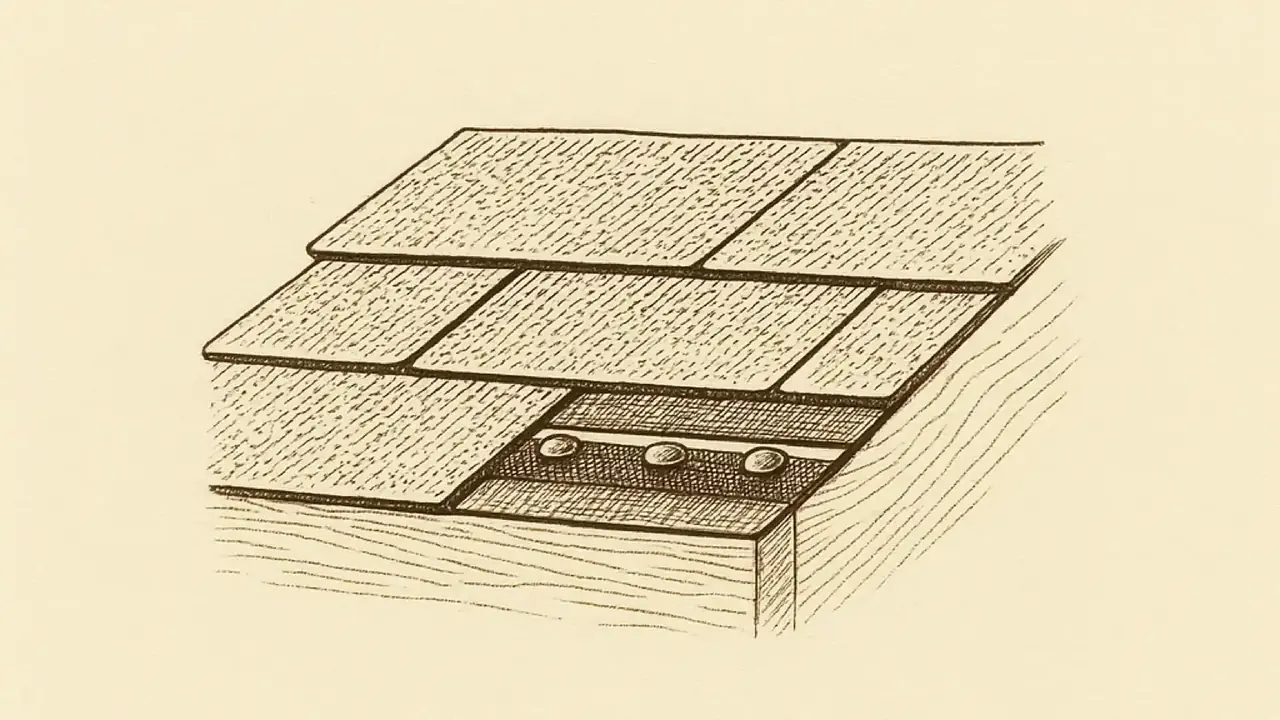 1
2
3
1
2
3
- The factory sealant strip — the bond between one course and the next. ASTM D7158 assigns its classes by measuring, on a testing machine, the force needed to break this bond
- The fastener line through the overlap — a nail placed in the zone the manufacturer prints passes through the course it is driven into and the head lap of the course below, so it holds two layers
- The cut edge of the head lap, where the exposed part of one course ends and the covered part begins — the geometry that decides whether a nail catches one layer or two
One design wind speed covers the whole city, and for a house it is 117 mph
Section 1609.3 of the 2022 New York City Building Code sends the reader to a table rather than to a map: “The basic design wind speed, V, in mph, for determining wind speed shall be that of Table 1609.3.”[BC 1609.3] The table lists one value per risk category, and its note states that the values are ultimate design 3-second gust wind speeds at 33 feet above ground for Exposure Category C. A dwelling is Risk Category II, which is the 117 mph row — a 700-year mean recurrence interval, 7 percent probability of exceedance in 50 years. Category I is 110 mph, III is 127, IV is 132. Section 1609.3.1 converts to the older allowable-stress basis with Vasd = 0.79V, putting a house at about 92.4 mph on that scale.
That covers most of the borough: 82.2% of the housing here is in one- and two-family buildings.[ACS 2024] The number is not a forecast. The same chapter prints a separate serviceability table of 3-second gusts by return period — 80 mph at 10 years, 87 at 25, 93 at 50 and 100 at 100 years[BC 1609.3.2] — which is why 117 mph is not a figure anyone expects on a weather report. It is a design basis, not a promise that shingles survive it.
Table 1504.1.1 turns that speed into two acceptable classifications, G and H
The path from the wind speed to the shingle is closed by an exception in the structural chapter: “Asphalt shingles installed over a roof deck complying with Section 1609.5.1 shall comply with the wind-resistance requirements of Section 1504.1.1.”[BC 1609.5.2] Section 1504.1.1 sits in Chapter 15 and reads:
“Asphalt shingles shall be tested in accordance with ASTM D 7158. Asphalt shingles shall meet the classification requirements of Table 1504.1.1 of this code for the appropriate maximum wind speed. Asphalt shingle packaging shall bear a label to indicate compliance with ASTM D 7158 and the required classification in Table 1504.1.1 of this code.”
“Exception: Asphalt shingles that are not included in the scope of ASTM D 7158 shall be tested and labeled to indicate compliance with ASTM D 3161 and the required classification in Table 1504.1.1.”
| Max. allowable stress design wind speed, Vasd (mph) | Max. basic design wind speed, V, from Table 1609.3 (mph) | ASTM D 7158 classification | ASTM D 3161 classification |
|---|---|---|---|
| 88 | 110 | D, G or H | A, D or F |
| 94 | 117 | G or H | A, D or F |
| 102 | 127 | G or H | F |
| 106 | 132 | G or H | F |
| Read across the 117 row: Class D drops out. A Class D shingle is acceptable at a 110 mph basic design wind speed, which is Risk Category I — not the category a dwelling falls in. | |||
The classification is required to be printed on the packaging, so it can be checked without trusting anyone
The label sentence is the most useful line in the chapter for a homeowner, because it moves the requirement off a PDF and onto an object sitting in the driveway hours before it goes up.
- Write the requirement into the contract in the code’s own words — asphalt shingles labelled to ASTM D7158 Class G or H — rather than a brand or a marketing tier name.
- Read a wrapper before the bundles are opened, and photograph the label panel. Wrappers are discarded within the hour, and it is the only copy of the manufacturer’s statement that will ever be on the property.
- Check that the printed designation is D7158 — or D3161, for a product outside D7158’s scope, where the same table permits Class A, D or F.
- Ask for the same thing on a repair. The requirement attaches to the shingles installed, not to the size of the job.
A wind speed in a brochure is a different statement from the code’s classification
Shingles are advertised with miles per hour rather than with a class letter, and the same three classes are quoted against two different wind-speed conventions. The National Roofing Contractors Association sets both out: against the basic design wind speed used by current editions of ASCE 7 — the convention Table 1609.3 uses — the classes are D 115 mph, G 150 mph and H 190 mph; against the older allowable-stress speeds, the same three are 90, 120 and 150 mph.[NRCA 2021] This is why 117 mph resolves to “G or H”: on the convention the code uses, Class G is a 150 mph product.
| Class | Against basic design wind speed V (the convention of Table 1609.3) | Against allowable stress design wind speed Vasd | Accepted at V = 117 mph? |
|---|---|---|---|
| D | 115 mph | 90 mph | No |
| G | 150 mph | 120 mph | Yes |
| H | 190 mph | 150 mph | Yes |
| A quoted “120 mph shingle” may be a Class G product described on the allowable-stress convention, and a quoted “110 mph” may be a warranty term rather than a classification at all. The class letter is the thing the code names; the convention has to be stated with any mph figure for it to mean anything. | |||
A warranty number is a third statement again. CertainTeed’s 2026 limited warranty for asphalt shingle residential products pairs each product with two wind figures — 110 mph and 160 mph on Landmark — and states that the higher figure applies only for the first fifteen years, and only where the shingles were not applied over existing shingles, the specified hip and ridge accessories were used as cap shingles, and the specified starter shingles were installed along eaves and rakes.[CertainTeed 2026] That is a contract term with three installation conditions attached, not a classification, and the first of the three is what a roof-over forfeits.
The two ASTM methods measure different things, and neither is a survival guarantee
ASTM D3161 is a fan test. Per NRCA, it delivers air streams across test specimens for two hours at 60, 90 or 110 mph — Classes A, D and F respectively[NRCA 2018] — and per the Insurance Institute for Business and Home Safety, the panels are installed, conditioned and tested at a 2:12 slope after being pre-sealed at 135–140 °F for 16 hours.[IBHS 2017] NRCA reports the standard’s own caution, that results “do not directly correlate to wind speeds experienced in service,” and notes it takes no account of building height, exposure or risk category.[NRCA 2018]
ASTM D7158 is not a fan test at all. IBHS describes two measurements and a comparison: uplift pressure coefficients are measured and used to calculate uplift forces at various design wind speeds, and uplift resistance comes from a second test in which a universal testing machine determines the force needed to break the sealant bond on a shingle section.[IBHS 2017] The class is assigned where the calculated force does not exceed the measured resistance. Nothing is blown at 190 mph; the 190 is arithmetic. IBHS puts the relationship between the two bluntly: D3161, with its two-hour load on a viscoelastic material, “is a more severe test,” and “virtually any shingle that achieves an ‘F’ rating from ASTM D3161 also achieves an ‘H’ rating using ASTM D7158.”
One limit of D7158 is worth carrying into a coastal borough. NRCA states that the procedures behind its classifications “assume asphalt shingles are applied to buildings located in Exposure Categories B or C, having mean roof heights not exceeding 60 feet and no topographic wind speed-up effects,” that the classifications exclude Ground Roughness D, and that designers should “use ASTM D7158 cautiously.”[NRCA 2021] The 2022 New York City Building Code publishes five borough shoreline sheets as Figure 1609.4.3, and the Staten Island sheet marks a coastal Exposure D zone along part of the shoreline.[BC 1609.4.3] A standard written for Exposures B and C is being applied on ground the same code map can assign to Exposure D — a stated tension between two named documents, not a defect claim and not a reason to buy a different wrapper. Where a site is drawn is a question for the exposure sheet and a design professional.
The classification describes a shingle whose sealant strip actually bonded
NRCA notes that ASTM D7158 addresses the wind resistance of asphalt shingles “with factory-applied, self-sealing strips.”[NRCA 2021] The class is a statement about a bond, so where the bond never formed, the letter on the wrapper describes a shingle that is not on the roof. IBHS states that its wind testing “has demonstrated that the most important factor affecting high-wind performance for self-sealing asphalt shingles is the strength of the seal between shingles.”[IBHS 2017]
That study weathered 80 panels outdoors — four products across five slopes from 2:12 to 12:12, north- and south-facing, installed in one summer and one winter — then wind tested them. Slope did not matter: average passing wind speeds ran 127, 126, 120, 121 and 117 mph from 2:12 to 12:12, and IBHS concluded that installation slope in that range “did not appear to influence the uplift resistance of the shingles.” Season and orientation did. Sealant activates with heat, and IBHS logged time above 140 °F: south-facing winter-installed panels averaged 165 hours above that threshold, north-facing winter-installed panels only 37, trending toward zero as slope increased. Of the north-facing winter-installed panels of two products, IBHS reports “only three panels out of 10 achieving a failure wind speed of 110 mph or higher.” The caution IBHS prints with those numbers belongs here too: an “exploratory investigation” with “a very limited data set,” one replication per condition, and results that are not to be read as one shingle type outperforming another.
The consequence is a question to ask before a winter start date. IBHS summarises manufacturer guidance as typically requiring hand-sealing on steep-slope surfaces or during extended cold, defined by some manufacturers as below 40 °F,[IBHS 2017] and CertainTeed’s printed instructions for its Landmark shingles direct spot cementing below 40 °F.[CertainTeed INST] Whether hand-sealing is included, and at what price, is a line a homeowner can require in writing on a January estimate.
The code’s fastening minimum is four per strip shingle, and where they land comes from the printed instructions
Section 1507.2.7 of the 2022 New York City Building Code requires asphalt shingles to be fastened with the manufacturer’s required minimum, “but not less than four fasteners per strip shingle or two fasteners per individual shingle.”[BC 1507.2.7] Section 1507.2.6 specifies the fastener: galvanized, stainless steel, aluminum or copper roofing nails, minimum 12 gage (0.105 in) shank, minimum 3/8 in head, complying with ASTM F1667, penetrating at least 3/4 in into the sheathing or through it where the deck is thinner.[BC 1507.2.6] Shingles “shall be fastened to solidly sheathed decks” (§ 1507.2.1) and are not permitted below a 2:12 slope, with double underlayment from 2:12 to 4:12 (§§ 1507.2.2, 1507.2.8). Six-nail patterns are a manufacturer’s requirement tied to warranty terms; four is the code floor, and the two are not the same thing.
Where the nails go is the manufacturer’s business, which the code adopts by requiring the manufacturer’s minimum. CertainTeed’s instructions for Landmark describe a NailTrak feature providing a 1-1/2 in wide nailing area, direct four nails for every full shingle in standard application, and call for six nails plus four spots of asphalt roofing cement on steep slopes, adding that failure to follow the steep-slope instructions “can void the warranty in the event of a shingle delamination.”[CertainTeed INST]
Placement carries weight because of the geometry drawn at (2) on the plate above. A nail in the printed zone passes through the shingle it is driven into and through the head lap of the course below, so it holds two layers. A nail set higher clamps one, and the course below is then held by its sealant strip alone; a nail in or above that strip also compromises the bond it was meant to protect, which is why the instruction sheets tell the installer to avoid the line. Because shingles are laid in courses, nailing high is rarely one bad fastener — it is whole courses with the wrong load path, which is what a continuous strip of missing shingles looks like as against scattered singles.
Tabs on the lawn are a question about the seal before they are a question about replacement
Losing tabs is not by itself a finding that a roof is finished. The mechanism runs in a fixed order: the sealant bond releases along a leading edge, the freed tab flutters and admits pressure beneath it, and the fastener line then carries prying load it was not detailed for. The useful question after a storm is therefore whether the seal across the rest of the field is intact, and the pattern of the loss is evidence about it. Damage at a rake, a ridge or one exposed corner is consistent with local pressure on a sound field; continuous courses gone across a plane, or tabs that lift by hand well away from the damage, point at a field-wide bond that never formed or has aged out.
Where the field is sound, replacing individual shingles keeps a serviceable roof in service, and the same rules travel with the repair: the replacement shingles carry the same classification requirement, § 1507.2.7’s fastening minimum applies to them, and cold-weather hand-sealing is the same manufacturer instruction it would be on a whole roof. Colour and profile rarely match a weathered roof exactly, which is a cosmetic cost rather than a performance one. Replacing the covering wholesale is a larger event with its own rule — § 1511.3 of the 2022 New York City Building Code requires roof replacement to include removal of all existing layers down to the roof deck, a separate question with its own exceptions. The classification requirement is identical either way; only the quantity of bundles changes.
What this page does not cover
This page covers the wind classification the 2022 New York City Building Code requires of asphalt shingles on a one- or two-family house, where that requirement is printed, and the fastening rules in the same chapter. It does not cover low-slope coverings, which are a different set of sections and where asphalt shingles are not permitted at all below a 2:12 slope; it does not cover the structural design of the roof, which lives in Chapter 16 and is a registered design professional’s work; it does not evaluate, compare or recommend any product or brand, and the two manufacturer documents cited here are cited because they were opened, not because they were selected on merit. It prices nothing and names no contractor. It makes no statement about what wind any particular roof will survive.
When a filing or a licensed professional is actually required: a reroof that stays above the deck requires no Department of Buildings permit under 1 RCNY § 101-14, Table 2, item IV.1, while one that replaces the deck or sheathing does, under item IV.2 of the same table — the permit line is the deck. Determining the wind exposure category at a site, and any engineered attachment that follows from it, requires a New York State registered architect or professional engineer; § 1609.4 of the 2022 New York City Building Code makes exposure a site determination, and no page can make it from a street address.
What this page does not establish
- Whether any particular shingle on any particular pallet carries the required classification. No product has been tested, inspected or purchased by anyone connected to this site, and no brand is asserted here to comply or not to comply. The label the code requires on the packaging settles it for one product on one day.
- How much more velocity pressure Exposure D produces than Exposure C or B at a low roof height. The exposure coefficients live in Table 26.10-1 of ASCE 7, which is paywalled and was never opened, so no percentage, multiplier or “much stronger” comparison appears anywhere above. Opening ASCE 7 would settle it.
- Anything from the IBHS FORTIFIED program, including its prescriptive deck-fastening requirements and which of its wind bands a house here falls in. The 2025 FORTIFIED Home Standard was not opened, and the program splits its bands at 115 mph on a site value from the ASCE hazard tool while the code’s Risk Category II value is 117 mph — two different instruments that may or may not agree at a given address. Opening the standard, and querying the hazard tool for a real address, would settle both.
- Whether shingles installed to current guidance fail below their design wind speed. A 2023 paper in the Journal of Wind Engineering and Industrial Aerodynamics addresses exactly that, and the publisher returned 403 to every attempt to read even the abstract, so nothing from it is stated above. Reading it would settle it.
- Whether nail placement changes pull-through resistance by any stated factor. The figure in circulation — roughly double, for correct placement over high placement — traces only to contractor blogs and to no test report, standard or association publication. The mechanism is described above; the multiplier is not published here. A named test would settle it.
- The highest wind gust ever measured in Richmond County. There is no long-record first-order National Weather Service station in the county, and the best primary-sourced measurement from a Staten Island site during Hurricane Sandy is flagged as incomplete in the report that carries it. No record gust figure appears above.
Sources
- [BC 1504.1.1]
- New York City Department of Buildings. 2022 New York City Building Code, Chapter 15 — Roof Assemblies and Rooftop Structures, as amended by Local Law 77 of 2023 (eff. 2023-06-10). § 1504.1.1 and Table 1504.1.1 (classification of asphalt shingles; packaging label); §§ 1507.2.1, 1507.2.2, 1507.2.6, 1507.2.7, 1507.2.8; § 1511.3. https://www.nyc.gov/assets/buildings/codes-pdf/cons_codes_2022/2022BC_Chapter15_RoofsRooftopsWBwm.pdf
- [BC 1609.3]
- New York City Department of Buildings. 2022 New York City Building Code, Chapter 16 — Structural Design. § 1609.3 and Table 1609.3 (basic design wind speed); § 1609.3.1 (Vasd = 0.79V); Table 1609.3.2 (serviceability wind speeds); §§ 1609.4, 1609.4.2 and 1609.4.3 with Figure 1609.4.3, sheet (5), “New York City Wind Exposure: Staten Island Shoreline,” page 33 of the chapter PDF; § 1609.5.2 Exception 2. https://www.nyc.gov/assets/buildings/codes-pdf/cons_codes_2022/2022BC_Chapter16_StructuralDesignWBwm.pdf
- [NRCA 2021]
- Graham, M.S. Understanding asphalt shingle standards. National Roofing Contractors Association, Professional Roofing, February 2021. ASTM D7158 class values against both wind-speed conventions; the exposure, height and roughness assumptions behind the classifications; the self-sealing-strip scope of the standard. https://www.professionalroofing.net/Articles/Understanding-asphalt-shingle-standards--02-01-2021/4817 · Retrieved 2026-08-06
- [NRCA 2018]
- Graham, M.S. The wind resistance of shingles. National Roofing Contractors Association, Professional Roofing, September 2018. ASTM D3161 durations and class speeds; the standard’s own caution that results do not directly correlate to wind speeds experienced in service. https://www.professionalroofing.net/Articles/The-wind-resistance-of-shingles--09-01-2018/4302 · Retrieved 2026-08-06
- [IBHS 2017]
- Estes, H.E., Smith, J.T., and Brown-Giammanco, T.M. Wind Uplift of Asphalt Shingles: Sensitivity to Roof Slope and Installation Temperature. Insurance Institute for Business & Home Safety, April 2017. Descriptions of what ASTM D3161 and ASTM D7158 physically do; the seal-strength finding; slope, orientation and installation-season results; hours above 140 °F; the study’s own limitations; manufacturer hand-sealing guidance below 40 °F. The PDF carries an IBHS members-only notice on its second page and is publicly reachable at the address below; it is quoted here sparingly and none of its figures are reproduced. https://ibhs.org/wp-content/uploads/member_docs/Wind-Uplift-of-Asphalt-Shingles_IBHS.pdf · Retrieved 2026-08-06
- [CertainTeed 2026]
- CertainTeed. Asphalt Shingle Residential Products, 2026 Limited Warranty. Table 1 product and wind figures; the fifteen-year limit on the upgraded wind figure and its three installation conditions. Cited as one manufacturer’s published document, not as an evaluation of the product. https://www.buildsite.com/pdf/certainteed/Landmark-Solaris-Shingles-Warranty-2953491.pdf · Retrieved 2026-08-06
- [CertainTeed INST]
- CertainTeed. Landmark PRO installation instructions (nailing area and pattern; four nails per full shingle; six nails and four spots of asphalt roofing cement on steep slopes with the delamination warranty note; nail gauge, head, length and penetration; spot cementing below 40 °F). Retrieved as a PDF hosted by a third-party product-data service rather than from the manufacturer’s own domain, which is stated here because the hosting matters to anyone re-checking it. https://www.buildsite.com/pdf/certainteed/Landmark-PRO-Installation-Instructions-2953189.pdf · Retrieved 2026-08-06
- [ACS 2024]
- U.S. Census Bureau. American Community Survey, 2024 1-year estimates, Richmond County, New York (FIPS 36085), tables B25024 and B25037, retrieved through the Census Reporter API. censusreporter.org · Retrieved 2026-08-06