When the 2022 New York City Building Code forbids shingling over an existing roof
Three findings about the roof that is already there put a second layer out of bounds outright under section 1511.3.1.1 of the 2022 New York City Building Code; below those three, the choice is a priced one, and the code still governs what has to come off.
Richmond County Roofing is an independent reference. It is not a contractor, it sells and installs nothing, and nobody associated with it has installed, hired, inspected or torn off a roof. Nothing on this page is an inspection, a determination or a recommendation about any particular building. The governing text throughout is the 2022 New York City Building Code, effective November 7, 2022, Chapter 15 as amended by Local Law 77 of 2023, effective June 10, 2023. Section numbers in Chapter 15 changed between the 2014 and 2022 editions and the edition is named in every citation below for that reason.
Applies to
Key figures
- Existing applications of roof covering above which a recover is prohibited
- 2 or more, of any type
- § 1511.3.1.1 2022 NYC Building Code VERBATIM [BC 1511.3.1.1]
- Roof replacement, required extent of removal
- all layers down to the roof deck
- § 1511.3 2022 NYC Building Code VERBATIM [BC 1511.3]
- Existing coverings over which a recover is prohibited outright
- slate · clay · cement · asbestos-cement tile
- § 1511.3.1.1 2022 NYC Building Code VERBATIM [BC 1511.3.1.1]
- Drainage required of any reroof, recover or replacement
- positive drainage
- § 1511.1.1 2022 NYC Building Code VERBATIM [BC 1511.1]
- Rusted, damaged or deteriorated flashing, metal edging, drain outlets, collars and counterflashing
- not reinstalled
- § 1511.5 2022 NYC Building Code VERBATIM [BC 1511.5]
- DOB permit for reroofing that stays above the deck or sheathing
- none subject to the energy-code proviso in the rule itself
- Table 2, IV.1 1 RCNY § 101-14, current through 2026-06-10 VERBATIM [1 RCNY 101-14]
 1
2
3
1
2
3
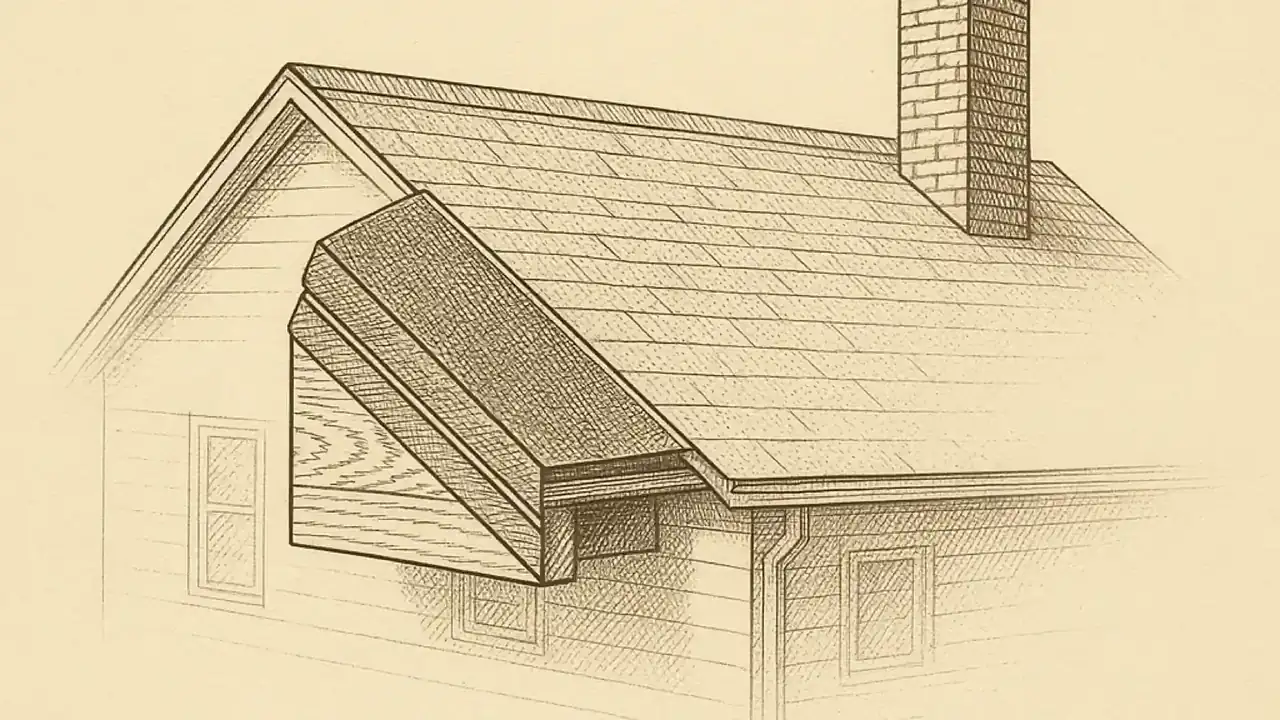
- The roof deck — the plane at which removal stops when a roof is replaced rather than recovered § 1511.3, 2022 NYC Building Code
- Stacked applications of roof covering — the count that decides the question, taken of applications of covering and not of individual shingles § 1511.3.1.1, 2022 NYC Building Code
- The cut edge — a rake, an eave or a vent penetration, where the stack can be seen from the side and counted before an estimate is written
Two or more existing applications of covering, and the code does not permit a recover at all
The trade calls the two jobs a tear-off and a roof-over. The 2022 New York City Building Code calls them a roof replacement and a roof recover, and it does not treat the choice between them as a preference. Section 1511.3.1.1 states three findings about the roof that is already on the building, any one of which removes the recover from the table.
“A roof recover shall not be permitted where any of the following conditions occur:
1. Where the existing roof or roof covering is water soaked or has deteriorated to the point that the existing roof or roof covering is not adequate as a base for additional roofing.
2. Where the existing roof covering is slate, clay, cement or asbestos-cement tile.
3. Where the existing roof has two or more applications of any type of roof covering.”
2022 ED. · CH. 15 AMENDED LL77/2023 The third condition is the one homeowners half-remember as “you can have two layers.” What the section says is narrower and harder: at two or more existing applications, a recover is not permitted[BC 1511.3.1.1], so the only remaining route is a replacement, and a replacement has its own definition. The unit being counted is an application of roof covering — a whole layer laid across the plane — not an individual shingle, and not a percentage of the roof area. On a house whose roof has already been gone over once, a third covering is outside the code no matter how sound the shingles below it look from the ground.
The second condition matters more here than the national version of this article would suggest. Slate and asbestos-cement tile are not exotic substrates in a borough where 17.7% of the housing stock predates 1940[ACS 2024], and where a tile or slate roof has often been covered rather than removed at some earlier point in its life. Where the existing covering is slate, clay, cement or asbestos-cement tile, section 1511.3.1.1 rules out a recover on that ground alone.
A roof replacement is defined by what comes off, not by what goes on
Section 1511.3 of the 2022 New York City Building Code fixes the depth of the work in one sentence, and it names a single exception.
“Roof replacement shall include the removal of all existing layers of roof coverings down to the roof deck.”
Exception: “Where the existing roof assembly includes an ice barrier membrane that is adhered to the roof deck, the existing ice barrier membrane shall be permitted to remain in place and covered with an additional layer of ice barrier membrane in accordance with Section 1507.”
“All existing layers” is the operative phrase, and the exception is the only material the code lets stay: an ice barrier membrane that is adhered to the deck, and then only if it is covered with a further layer of ice barrier membrane[BC 1511.3]. An ice barrier, at section 1507.2.8.1 of the same edition, is “at least two layers of underlayment cemented together or … a self-adhering polymer modified bitumen sheet,” used in lieu of normal underlayment[BC 1507.2.8.1]. Ordinary felt underlayment left in place is not that exception, and neither is a sound-looking bottom course of shingles.
Section 1511.3.1 names the cases in which a recover is permitted, and a contractor proposing one should be able to say which case applies
Below the three prohibitions, the code does not simply fall silent and allow anything. Section 1511.3.1 states the roof recovers that are permitted, as an enumerated list: a new covering installed in accordance with the manufacturer's instructions; complete and separate roofing systems, such as standing-seam metal panel systems, that transmit roof loads directly to the building's structure and do not rely on the existing roof for support; metal panel, metal shingle, and concrete or clay tile installed over an existing wood shake roof in accordance with section 1511.4; and a new protective coating over an existing spray polyurethane foam roofing system[BC 1511.3.1].
That third item carries a condition of its own. Where a recover over an existing wood shingle or wood shake roof creates a combustible concealed space, section 1511.4 requires the entire existing surface to be covered first with gypsum board, mineral fiber, glass fiber or other approved material, securely fastened in place[BC 1511.4]. That is an extra material and an extra labour operation, and it belongs on the estimate as a priced line rather than in a conversation on the driveway.
The question resolves on findings about the existing roof, and not on a percentage of it
The decision has a shape. Each row below is a fact about the roof that is already there, and the code's answer to it. There is no threshold expressed as a share of the roof anywhere in section 1511.3.1 or section 1511.3.1.1.
| Finding about the existing roof | Recover | Section, 2022 edition | What the code requires instead |
|---|---|---|---|
| Two or more applications of any type of covering | Not permitted | § 1511.3.1.1(3) | Removal of all existing layers down to the deck, § 1511.3 |
| Covering is slate, clay, cement or asbestos-cement tile | Not permitted | § 1511.3.1.1(2) | Replacement; existing slate or tile may be reinstalled except where damaged, cracked or broken, § 1511.5 |
| Existing roof water soaked, or deteriorated past being an adequate base for additional roofing | Not permitted | § 1511.3.1.1(1) | Replacement. Whether a given roof meets this description is a finding about a specific building |
| A single sound application, new covering installed to the manufacturer's instructions | Permitted | § 1511.3.1(1) | Compliance with the rest of Chapter 15, including § 1511.1.1 drainage and § 1511.6 flashings |
| A complete separate system, such as standing-seam metal panel, transmitting loads to the structure | Permitted | § 1511.3.1(2) | The system must not rely on the existing roof for support |
| Metal panel, metal shingle, or concrete or clay tile over an existing wood shake roof | Permitted | § 1511.3.1(3) | Where a combustible concealed space is created, the whole existing surface is first covered per § 1511.4 |
| New protective coating over an existing spray polyurethane foam roof | Permitted | § 1511.3.1(4) | Compliance with the rest of Chapter 15 |
| Every section in this table is from the 2022 New York City Building Code, Chapter 15, as amended by Local Law 77 of 2023. The same subject matter is at § 1510 in the 2014 edition and the subsection numbers do not correspond. | |||
Deteriorated flashing and metal edging may not be reinstalled on either route
The layer count is the loudest part of section 1511, and not the part that leaks first. Section 1511.5 provides that existing vent flashing, metal edgings, drain outlets, collars and metal counterflashings “shall not be reinstalled where rusted, damaged or deteriorated,” that damaged, cracked or broken slate or tile shall not be reinstalled, and that aggregate surfacing shall not be reinstalled[BC 1511.5]. Section 1511.6 then states that flashings “shall be reconstructed” in accordance with the manufacturer's installation instructions, and that metal flashing to which bituminous material is to adhere must be primed first[BC 1511.6].
Reused flashing is one of the cheapest lines to leave out of a bid and one of the most common places a reroofed roof fails. Under those two sections, reusing metal that is rusted, damaged or deteriorated is not a judgement call about workmanship; it is outside the code. An estimate that says nothing at all about step flashing, counterflashing, valley metal or drip edge is an estimate in which that work has not been priced, whichever route the job takes.
A recover on the low-slope rear extension still has to drain, and the covering has a reflectance requirement
Section 1511.1.1 of the 2022 New York City Building Code is seven words long: “Reroofs shall provide positive drainage.”[BC 1511.1] A recover laid over a rear extension that already ponds does not satisfy it, because the new covering follows the plane of the old one. Section 1511.2 adds that the structural roof components must be capable of supporting the roof-covering system together with the material and equipment loads encountered during installation — the sentence that bears on adding weight to an existing assembly rather than removing it.
Reflectance comes in through a threshold that is frequently misremembered as a permit rule. Section 1504.9 of the 2022 edition requires a roof with a slope of 2:12 or less to have an initial solar reflectance of at least 0.70 and a thermal emittance of at least 0.75, or a solar reflectance index of at least 82[BC 1504.9]. Section 1511.1 Exception 1 lifts section 1504.9 only where the area recovered or replaced is both less than 50% of the roof area and less than 500 sq ft (46.5 m²)[BC 1511.1]. Both conditions have to be met. It is a reflectance carve-out, not a permit threshold and not a licence to skip anything else in Chapter 15.
Repair is a separate branch, and the code keeps it separate
Section 1511 governs reroofing — recovering or replacing a roof covering across a plane. It is not the section that governs replacing a cracked boot at a vent, rebuilding a valley, reconstructing a chimney counterflashing, or resetting a run of drip edge. Those are repairs, and 1 RCNY § 101-14 Table 2, item IV.1 lists “Roof repair and reroofing above the deck/sheathing” together in the same permit-exempt row, described as “Roof repair or replacement, limited to the roof membrane, roof coverings, cant strip, and any insulation above the roof deck/sheathing”[1 RCNY 101-14].
Two consequences follow that are worth holding on to. First, a repair does not become a reroof because a contractor prefers to sell one; the section that forces a full strip, § 1511.3, applies to a roof replacement, and the conditions that forbid a recover, § 1511.3.1.1, apply when a new covering is being laid over the whole plane. Second, on a slate roof the code points the other way from the sales pitch: section 1511.5 expressly permits existing slate and tile to be reinstalled, excluding only what is damaged, cracked or broken[BC 1511.5], which is the code's own description of a slate repair. A proposal to strip a slate roof and shingle it is a proposal to replace a covering the code contemplates being taken up and put back.
A recover can also cost the wind term the shingle was sold on
The code sets the floor. The warranty document sets what the manufacturer will pay, and it is a separate instrument with separate conditions. In CertainTeed's Asphalt Shingle Residential Products, 2026 Limited Warranty, the upgraded 130 mph and 160 mph wind terms apply only for the first 15 years, and only where the shingles are not applied over existing shingles, where the manufacturer's specified hip and ridge accessories are used as cap shingles, and where the manufacturer's specified starter shingles are installed along eaves and rakes[CertainTeed 2026]. A roof-over, on that document's own terms, forfeits the wind figure the shingle was named for at the door.
That is one manufacturer's document, opened and read. Other manufacturers publish their own, and none of the others were opened for this page. The reader action that follows is not to accept a number spoken aloud: ask for the warranty document by name and edition for the product actually being installed, and read the conditions attached to its wind term.
What to put in writing before the layer question is answered for you
Every item below is answerable from documents, and each one corresponds to a section quoted above. None of them requires a homeowner to get on a roof.
- The number of existing applications of roof covering, stated as a number, and where on the building it was counted — a rake, an eave or a penetration, per § 1511.3.1.1 of the 2022 New York City Building Code.
- Which route the estimate prices: removal of all existing layers down to the deck under § 1511.3, or a recover, and if a recover, which item of § 1511.3.1 it relies on.
- A separate priced line for flashings, stating what is being reconstructed rather than reinstalled, per § 1511.5 and § 1511.6.
- For a low-slope rear extension, what the finished slope drains to, given that § 1511.1.1 requires positive drainage of a reroof.
- The manufacturer's warranty document for the product being installed, with the conditions on its wind term readable in the document rather than described.
What this page does not cover
This page is about section 1511 of the 2022 New York City Building Code and the choice between a recover and a replacement. It does not cover what a roof costs, what a permit costs, asbestos survey obligations, landmarks review, or how a new low-slope membrane is attached — torch application over combustible construction has a separate published FDNY position and is treated on its own page. It states no requirement of the New York City Energy Conservation Code, whose current edition was not opened here.
A DOB filing is required when the work includes replacement of the roof deck or sheathing: 1 RCNY § 101-14 Table 2, item IV.2 covers “Roof repair or replacement that includes replacement of roof deck/sheathing,” and it is not permit-exempt[1 RCNY 101-14]. That rule also states, at § 101-14(c), that an exemption does not eliminate an owner's obligation to file at other city agencies, and at § 101-14(a) that the listed categories “may” be classified as ordinary repairs and that the tables are “not an exclusive list.” Whether a particular existing roof is “water soaked or has deteriorated to the point that [it] is not adequate as a base for additional roofing” under § 1511.3.1.1 is a finding about a specific building, which this site has not made and cannot make; that determination, and any question about whether a given assembly can carry an added covering under § 1511.2, belongs to the Department of Buildings or to a New York-licensed registered architect or professional engineer.
What this page does not establish
- How many applications of roof covering exist on any particular house. The count is read at a cut edge or a penetration on the building itself, and nothing on this site is an inspection of any building. Opening the stack at a rake or an eave settles it.
- How a wood shake substrate under a later covering is treated on a specific roof. The 2014 edition named wood shake in its prohibition list and the 2022 edition does not, handling it instead at § 1511.3.1 item 3 and § 1511.4. Which of those provisions governs a given assembly would be settled by a Department of Buildings determination or by a New York-licensed registered architect or professional engineer.
- Whether the New York City Energy Conservation Code requires additional thermal insulation on any given reroof. The permit exemption at 1 RCNY § 101-14 Table 2, item IV.1 is expressly conditioned on it, and no nyc.gov edition of the energy code was opened for this page, so no section of it is cited here. Opening the adopted energy code would settle both the requirement and its section number.
- What manufacturers other than CertainTeed require of a roof-over as a condition of a wind warranty. Only the CertainTeed 2026 limited warranty was opened. Obtaining each manufacturer's current warranty document would settle it.
- The code's own definitions of “positive roof drainage” and “low-slope roof.” Section 1502 of the 2022 New York City Building Code lists them as defined terms whose text lives in Chapter 2 of that edition, which was not opened for this page. Opening Chapter 2 would settle the wording.
Sources
- [BC 1511.1]
- New York City Department of Buildings. 2022 New York City Building Code, Chapter 15 — Roof Assemblies and Rooftop Structures, as amended by Local Law 77 of 2023 (eff. 2023-06-10), § 1511.1 including Exception 1, § 1511.1.1 and § 1511.2. nyc.gov PDF
- [BC 1511.3]
- New York City Department of Buildings. 2022 New York City Building Code, Chapter 15, § 1511.3, Roof replacement, and its exception. nyc.gov PDF
- [BC 1511.3.1]
- New York City Department of Buildings. 2022 New York City Building Code, Chapter 15, § 1511.3.1, Roof recover, items 1 to 4. nyc.gov PDF
- [BC 1511.3.1.1]
- New York City Department of Buildings. 2022 New York City Building Code, Chapter 15, § 1511.3.1.1, the three conditions under which a roof recover is not permitted. nyc.gov PDF
- [BC 1511.4]
- New York City Department of Buildings. 2022 New York City Building Code, Chapter 15, § 1511.4, Roof recovering over wood shingles or wood shakes where a combustible concealed space is created. nyc.gov PDF
- [BC 1511.5]
- New York City Department of Buildings. 2022 New York City Building Code, Chapter 15, § 1511.5, Reinstallation of materials. nyc.gov PDF
- [BC 1511.6]
- New York City Department of Buildings. 2022 New York City Building Code, Chapter 15, § 1511.6, Flashings. nyc.gov PDF
- [BC 1504.9]
- New York City Department of Buildings. 2022 New York City Building Code, Chapter 15, § 1504.9, Reflectance — initial solar reflectance and thermal emittance thresholds by roof slope. nyc.gov PDF
- [BC 1507.2.8.1]
- New York City Department of Buildings. 2022 New York City Building Code, Chapter 15, § 1507.2.8.1, Ice barrier — the definition relied on by the exception to § 1511.3. nyc.gov PDF
- [BC 2014 1510.3]
- New York City Department of Buildings. 2014 New York City Building Code, Chapter 15 — Roof Assemblies and Rooftop Structures, § 1510.3, Recovering versus replacement. Superseded edition, cited only to show the change in the prohibition list. nyc.gov PDF
- [1 RCNY 101-14]
- New York City Department of Buildings. 1 RCNY § 101-14, Categories of Work That May or May Not Require a Permit, Table 2, items IV.1 and IV.2, and subsections (a) and (c). Rule effective 2011-10-02; most recent amendment effective 2026-06-10, which did not change the roofing rows. nyc.gov PDF · Retrieved 2026-08-06
- [CertainTeed 2026]
- CertainTeed. Asphalt Shingle Residential Products, 2026 Limited Warranty, wind warranty upgrade conditions. Manufacturer document, applicable to CertainTeed products only. buildsite.com PDF · Retrieved 2026-08-06
- [ACS 2024]
- U.S. Census Bureau. American Community Survey, 2024 1-year estimates, Richmond County, New York (FIPS 36085), table B25034, year structure built, retrieved through the Census Reporter API. censusreporter.org · Retrieved 2026-08-06