FDNY’s published position on torch-applied roofing over combustible construction
The Fire Department’s own study material states that installing roofing material with a torch on a roof of combustible construction is illegal — and the flat rear extension where torch-down is most often sold in this borough is ordinarily built on a wood deck.
This is an independent reference. It is not a contractor, it performs no inspections, and nothing here is a determination about any particular building. Nobody associated with it has installed, repaired or inspected a roof. The construction codes cited on this page are the 2022 New York City Construction Codes, effective November 7, 2022; the fire requirements are quoted from the Fire Department’s own published certificate-of-fitness study material. Whether a specific roof is of combustible construction is a classification question this page does not answer for anyone.
Applies to
- Detached
- Semi-detached
- Attached
- Two-family
- Low-slope rear extension
- Party-wall parapet
Key figures
- Torch application on a roof of combustible construction
- Illegal FDNY’s published position
- § 1.4.3 FDNY G-60 study material, rev. January 2026 VERBATIM [FDNY G-60]
- Certificate of Fitness held by the person on the torch
- G-60 renews every three years
- Certificate of Fitness G-60 FDNY certification page and G-60 study material, rev. January 2026 VERBATIM [FDNY G-60]
- Fire watch, held by a second person
- F-60 on any rooftop torch-applied roofing operation
- Certificate of Fitness F-60 FDNY certification page and F-60 study material VERBATIM [FDNY F-60]
- FDNY permit for open flame in a torch-applied roofing system
- Required 12 months maximum, non-transferable, kept on the premises
- FDNY Permits, item (6) FDNY G-60 study material, rev. January 2026 VERBATIM [FDNY G-60]
- DOB permit for a reroof that stays above the deck
- Not required and the exemption does not reach the Fire Department
- 1 RCNY § 101-14, Table 2, IV.1 and (c) New York City Department of Buildings rule, retrieved 2026-08-06 VERBATIM [1 RCNY 101-14]
- Clearance from combustibles for hot work
- 25 ft 35 ft for cutting or welding; otherwise appropriate shielding
- Hot work clearances FDNY G-60 study material, rev. January 2026 VERBATIM [FDNY G-60]
 1
2
3
1
2
3
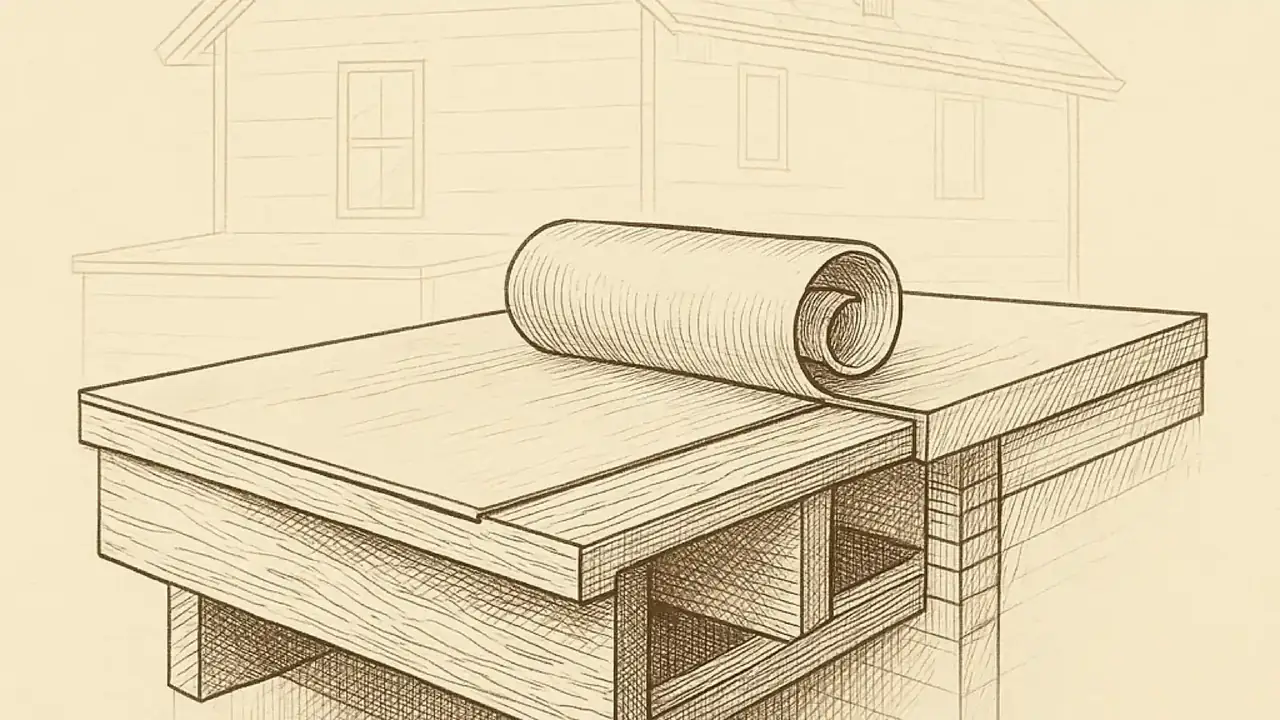
- The deck boards and the joists beneath them — the wood that makes the assembly a combustible one, and the surface the flame is held against
- The concealed space between joists, which a flame reaches through a knot, a split or an open board joint and which nobody on the roof can see into
- The membrane roll on the deck — the sheet is heated on its underside as it is unrolled, so the flame travels along the boards ahead of it
FDNY’s study material calls torch application on a roof of combustible construction illegal, in those words
Torch-applied roofing is sold as the ordinary way to cover a flat rear extension. The Fire Department publishes the study material for the certificate a torch operator must hold, and it carries a prohibition no consumer page repeats.[FDNY G-60]
“It is illegal to install any roofing material using a torch on a roof of combustible construction or in roofing operations on roofs of combustible construction using hot work equipment.”
The booklet for the fire guard who must watch the operation prints it slightly differently: “It must be unlawful to install any roofing material using a torch on a roof of combustible construction or otherwise engage in roofing operations on roofs of combustible construction using hot work equipment.”[FDNY F-60] Two Fire Department publications, aimed at the two people who would be standing on the roof, carry it.
Where that prohibition sits in the codified Fire Code is the one part of it this page will not give you a number for.
The rule turns on what the roof is made of, not on where the house is
Combustible construction is a Building Code classification, and this page classifies nothing. If the roof is of combustible construction — which is what an ordinary wood-framed, wood-decked roof is — then FDNY’s published position is that torch application on it is unlawful. The conditional is the whole claim. A sentence of the form “torch-down is illegal on Staten Island” would assert a classification that only the Department of Buildings or a New York State registered design professional can make.
What the housing stock makes likely is still a separate matter from what any single roof is. 82.2% of the housing here is in one- and two-family buildings and the median unit was built in 1974[ACS 2024], and the low-slope rear extension on a house of that vintage is normally framed and sheathed in wood. The surface most often proposed for torch application is the surface the prohibition is written about, which is why the question belongs before the propane arrives.
A lawful torch operation in this city takes two certified people and a separate permit
Where torch work is permitted, the requirements are personal. FDNY’s certification page states: “Torch operations using oxygen and a flammable gas, and any torch operation for torch-applied roofing systems, shall be performed by a certificate of fitness holder.”[FDNY G-60] The booklet is specific about who does the holding — the operation “must be personally done by a Certificate of Fitness holder.”[FDNY G-60] A torch running on LPG or CNG without oxygen qualifies under G-41, G-42 or G-60; with oxygen connected, it is G-60. The certificate renews every three years.
The second person is not optional and is not the same person. FDNY lists the fire watch conducted by F-60 fire guards as required on any rooftop and in connection with any torch-applied roofing system operation.[FDNY F-60] The booklet states it plainly: “At a construction site and torch-applied roofing system operation, every torch operator must also have a fire watch by a F-60 fire guard.” One guard may cover more than one operation only where they are on the same level, each within 50 ft and within the guard’s field of view. So a compliant torch job is a minimum of two certified people, and a two-person crew with one of them on the torch is not that.
A permit is required on top of the certificates. The booklet’s list of hot work for which FDNY permits are required includes, at item (6), “use of any open flame in a torch-applied roofing system.”[FDNY G-60] Permits are site-specific or citywide, valid for a maximum of 12 months, non-transferable, and readily available on the premises for inspection. The same booklet sets the clearances that make the paperwork physical: cutting or welding at least 35 ft from combustible material or waste, all other hot work at least 25 ft, or appropriate shielding; a check before the work is authorised and at least once a day while it is; and check reports kept at the site for at least 48 hours after completion.
No Department of Buildings permit is required for most reroofs, and that changes none of this
A reroof that stays above the deck — membrane, coverings, cant strip, insulation above the sheathing — is listed at 1 RCNY § 101-14, Table 2, item IV.1 as work needing no Department of Buildings permit,[1 RCNY 101-14] which is the most common way a homeowner is told no paperwork exists on the job. The same rule says otherwise, in subdivision (c):
“Any exemptions outlined by this rule will not grant authorization for any work to be done in a manner that violates the provisions of this code, the New York City Energy Conservation Code, the Zoning Resolution or any other laws, rules, or regulations. Such exemptions shall not eliminate the obligation of any owner to file at other City agencies, when appropriate, including but not limited to the Landmarks Preservation Commission, the City Planning Commission, Department of Transportation, Department of Environmental Protection, Department of Environmental Conservation, or the Fire Department…”
The obligation named there is the owner’s, not the contractor’s, and the sequence is therefore: no Department of Buildings permit for the reroof itself, and still an FDNY permit, a G-60 holder and an F-60 fire guard if the method is a torch. Note also that § 101-14(a) describes these as categories that may be classified as ordinary repairs, and that the tables are not an exclusive list.
The prohibition is about the flame, so it applies to a patch as much as to a new roof
Nothing in the quoted sentences is scoped to a full replacement. Both read on “roofing operations,” and a torch held over a lap to reseal fifteen feet of an otherwise sound membrane is a roofing operation using hot work equipment on the same deck. Repair is often the right work on a low-slope roof: the failures on this housing stock concentrate at laps and at the base flashing where the membrane turns up a parapet or a wall rather than across the field, and a correctly scoped repair keeps a serviceable membrane in service. What the Fire Department’s rule asks is not how much of the roof is being worked on but whether an open flame is being used on it — so a small torched repair carries the same permit, certificate and fire-watch requirements as a torched replacement, and the low price of the repair is not a reason they relax.
Four low-slope systems in the same code chapter go on without an open flame
Modified bitumen is a material, not an application method: the sheet normally torched is APP-modified, while SBS-modified sheet comes self-adhered or cold-applied and is listed against the same standards in the same code section. The three membrane systems below carry identical drainage language in the 2022 New York City Building Code — each “shall have a slope designed and built to provide positive roof drainage,” §§ 1507.11.1, 1507.12.1 and 1507.13.1[BC 1507.11.1] — so what separates them is not drainage. It is what is held over the deck.
| System | Section, 2022 NYC Building Code | Standards named in that section | Open flame at installation |
|---|---|---|---|
| Modified bitumen, torch-applied (typically APP) | § 1507.11 | CGSB 37-GP-56M; ASTM D6162, D6163, D6164, D6222, D6223, D6298, D6509 | Yes — the operation the FDNY booklets are written about |
| Modified bitumen, self-adhered or cold-adhesive-applied (typically SBS) | § 1507.11 | same list | No |
| Thermoset single-ply (EPDM), fully adhered | § 1507.12 | ASTM D4637, D5019; CGSB 37-GP-52M | No |
| Thermoplastic single-ply (TPO, PVC), heat-welded seams | § 1507.13 | ASTM D4434, D6754, D6878; CAN/CGSB 37-54 | No open flame; seams fused by hot-air welder. FDNY hot-work status not established: no primary source opened |
| Standing-seam metal panel system, slope not less than 1/4:12 | § 1507.4.2, item 3 | — | No |
| The cell marked —— had no primary source that this site opened. The FDNY booklets define hot work around torches, open flame, arc welding and asphalt melters and do not mention hot-air seam welding, so heat-welded single-ply is not presented here as exempt from anything. It is left empty rather than filled from inference. | |||
The rules were written after a torch fire, and the booklet says the flame is not the usual ignition source
The G-60 booklet carries its own account of why the requirements exist. Torch-applied modified bitumen came into wide use in the early 1980s. On , roofers using propane torches to install modified bitumen started a three-alarm fire that destroyed 30 apartments at 327 West 30th Street in Manhattan; the booklet records that the torch operator and the roofing company owner were arrested for reckless endangerment of property, that the contractor lacked the proper permits, and that the incident drove the adoption of the city’s torch rules.[FDNY G-60] The same booklet states that sparks and slag rather than the flame itself are the ignition source in about 60% of fires in industrial occupancies — the Fire Department’s figure, in a Fire Department publication, with the underlying study unnamed in it, reproduced here with that attribution and nothing derived from it. Both accounts point at the geometry the plate above draws: what ignites is behind or below the surface anyone is watching, which is why the second person exists and why the check reports outlast the crew by 48 hours.
What to ask for, in the words the documents use
- Ask what the deck is. Boards or plywood over wood joists is what the term “combustible construction” describes; the Building Code classification of the building itself is a separate determination, and it belongs to the Department of Buildings or a New York State registered design professional.
- Ask for the method by name on the estimate — torch-applied, self-adhered, cold-applied, heat-welded or seamed metal — rather than “rubber roof,” which names none of them.
- If torch application is proposed, ask to see the FDNY permit for use of an open flame in a torch-applied roofing system, which the booklet says must be readily available on the premises.
- Ask which person on the crew holds the G-60 — the booklet requires the operation to be personally done by the holder — and which separate person holds the F-60 and will be on fire watch.
- Ask for the daily hot-work check reports, kept at the site for 48 hours after completion.
A contractor who proposes to torch a wood-decked extension and cannot produce those documents is describing an operation FDNY’s publications say is not permitted.
What this page does not cover
This page covers one method of installing one class of roof covering and the Fire Department’s published requirements for it. It does not tell you what your roof is made of, what construction type your building is, or whether a torch may lawfully be used there. It does not address asbestos, which is a separate obligation with its own agency — only a Department of Environmental Protection certified asbestos investigator can establish whether asbestos-containing material is present in an older roof, and that obligation does not run through the Department of Buildings’ permit intake. It does not cover fire-resistance ratings, party-wall construction or what a parapet must be built of, it prices nothing, and it names no contractor.
When a filing or a licensed professional is actually required: a reroof that replaces the deck or sheathing requires a Department of Buildings permit under 1 RCNY § 101-14, Table 2, item IV.2; one that stays above the deck does not, and § 101-14(c) preserves the obligation to file with the Fire Department regardless. Torch work requires an FDNY permit, a G-60 holder and an F-60 fire guard. Any structural question about the extension, and the construction type of the building, requires a New York State registered design professional.
What this page does not establish
- The Fire Code section number that codifies the prohibition. The text is confirmed twice from FDNY publications; the number attributed to it in commercial code libraries was never read in the code itself. Reading the codified 2022 New York City Fire Code would settle it.
- Whether FDNY treats hot-air welding of thermoplastic single-ply as hot work requiring a permit or a Certificate of Fitness. The booklets define hot work around torches, open flame, arc welding and asphalt melters and never mention hot-air seam welding. A determination from FDNY would settle it; until one exists, heat-welded TPO or PVC is not described here as free of FDNY paperwork.
- Which Building Code construction type any particular house is. Chapter 6 of the 2022 New York City Building Code classifies construction types; that chapter was not opened for this page and no building is classified here. A registered design professional’s statement would settle it for one address.
- How often the prohibition is enforced, on what charge, and against whom. Two recent enforcement events appear in secondary reporting and the FDNY releases behind them were not opened, so nothing is published here beyond the 1999 fire the booklet itself recounts. Opening those releases would settle it.
- What the booklet’s 60% sparks-and-slag figure rests on. The publication does not name the study. Nothing here is derived from the number; naming the study would settle whether it can carry more than an attributed illustration.
- Whether New York homeowner policies commonly exclude loss caused by unpermitted hot work. Not researched, and separate from the Fire Code. Reading the exclusions in a specific policy form would settle it.
Sources
- [FDNY G-60]
- New York City Fire Department. Study Material for the Certificate of Fitness for Torch Use of Flammable Gases (G-60), revised January 2026. § 1.4.3 (prohibited operations); Certificate of Fitness requirement; FDNY Permits, item (6); hot work clearances, daily check reports and record retention; “Torch Fire History.” https://www.nyc.gov/assets/fdny/downloads/pdf/business/cof-g60-noe-study-materials.pdf · Retrieved 2026-08-06
- [FDNY F-60]
- New York City Fire Department. Study Material for the Certificate of Fitness for Fire Guard for Torch Operations (F-60). § 1.3.3 (prohibited operations); fire watch required at torch-applied roofing system operations; the 50 ft and field-of-view limit on covering more than one operation. https://www.nyc.gov/assets/fdny/downloads/pdf/business/cof-f60-noe-study-materials.pdf · Retrieved 2026-08-06
- [FDNY G-60] certification page
- New York City Fire Department. Certificate of Fitness for Torch Use of Flammable Gas (G-60), certification page: who must perform torch operations; three-year renewal. https://www.nyc.gov/site/fdny/business/all-certifications/cof-g60.page · Retrieved 2026-08-06 with a browser user agent; this host returns 403 to automated clients.
- [FDNY F-60] certification page
- New York City Fire Department. Certificate of Fitness for Fire Guard for Torch Operations (F-60), certification page: where a fire watch conducted by F-60 fire guards is required, including on any rooftop and in connection with any torch-applied roofing system operation. https://www.nyc.gov/site/fdny/business/all-certifications/cof-f60.page · Retrieved 2026-08-06 with a browser user agent; this host returns 403 to automated clients.
- [1 RCNY 101-14]
- New York City Department of Buildings. 1 RCNY § 101-14, Categories of work that may or may not require a permit. Table 2, section IV (Roofs), items IV.1 and IV.2; § 101-14(a); § 101-14(c). https://www.nyc.gov/assets/buildings/rules/1_RCNY_101-14.pdf · Retrieved 2026-08-06
- [BC 1507]
- New York City Department of Buildings. 2022 New York City Building Code, Chapter 15 — Roof Assemblies and Rooftop Structures, as amended by Local Law 77 of 2023 (eff. 2023-06-10). §§ 1507.4.2, 1507.11, 1507.11.1, 1507.11.2, 1507.12, 1507.12.1, 1507.12.2, 1507.13, 1507.13.1, 1507.13.2. https://www.nyc.gov/assets/buildings/codes-pdf/cons_codes_2022/2022BC_Chapter15_RoofsRooftopsWBwm.pdf
- [ACS 2024]
- U.S. Census Bureau. American Community Survey, 2024 1-year estimates, Richmond County, New York (FIPS 36085), tables B25024, B25034 and B25037, retrieved through the Census Reporter API. censusreporter.org · Retrieved 2026-08-06