The hurricane deductible is a percentage of the dwelling limit, not a flat $1,000
A hurricane or windstorm deductible on a New York homeowners policy is calculated from the amount the whole dwelling is insured for rather than from the size of the loss, so the figure subtracted from a roof claim is set by the value of the house rather than by the extent of the damage, and it bears no relation to the flat amount on the line most households are used to reading.
This is an independent reference. It is not a contractor and not an insurance producer, adjuster or broker; it sells nothing, inspects nothing and refers no one, and nobody associated with it has installed a roof, hired a roofer or filed a claim on one. Nothing here is an inspection, a coverage opinion or a determination about your building or your policy — the only document that states what any particular household is covered for is that household's own policy, and the figures below are the filed and published ones, not anybody's. The instruments governing this page are the New York Insurance Law and Department of Financial Services material, not the construction code; where the construction code is named it is the 2022 New York City Construction Codes, effective November 7, 2022, with Chapter 15 as amended by Local Law 77 of 2023, effective June 10, 2023.
Applies to
Detached Semi-detached Attached Two-family Low-slope rear extension Party-wall parapet
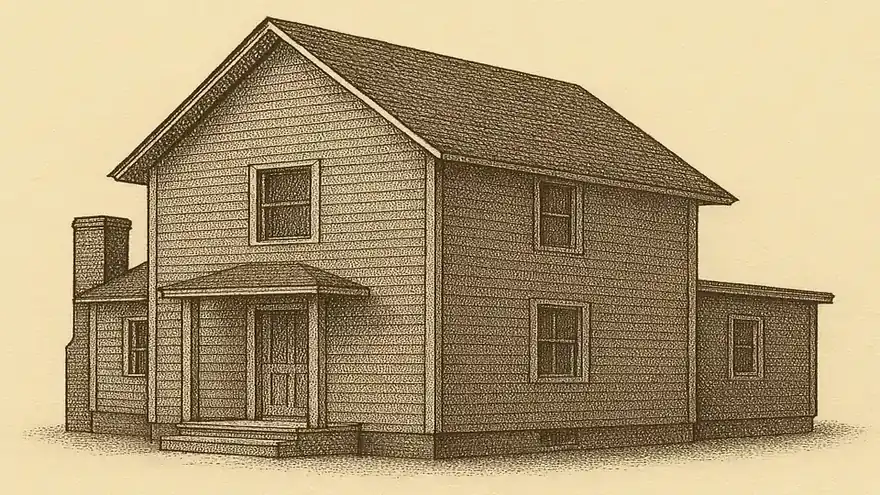
Every chip is filled, and the reason is the subject of the page. A percentage deductible is computed from the amount of insurance on the dwelling, so it does not know which part of the building was damaged. The pitched planes, the flat rear extension and the parapet all sit inside one insured object and behind one deductible figure.
Key figures
- Hurricane deductible filed by Allstate for coastal areas including Staten Island
- 5% of dwelling value
- Approved Independent Mandatory Hurricane Deductibles NY DFS, rev. 2019-12-13 VERBATIM [DFS DEDUCTIBLES]
- Hurricane deductible filed by A. Central Insurance Co. for Richmond County
- 3% with optional 4% and 10% forms in the same filing
- Approved Independent Mandatory Hurricane Deductibles NY DFS, rev. 2019-12-13 VERBATIM [DFS DEDUCTIBLES]
- Hurricane deductible filed by ACA Insurance Company for Richmond County
- 1% of the dwelling's insured value
- Approved Independent Mandatory Hurricane Deductibles NY DFS, rev. 2019-12-13 VERBATIM [DFS DEDUCTIBLES]
- The one flat figure in the Richmond County rows — Adirondack Insurance Exchange, HO 4000 and HO 6000 forms
- $1,000 a flat amount; the same carrier's HO 2000 and HO 3000 forms carry an optional 1% to 5% instead
- Approved Independent Mandatory Hurricane Deductibles NY DFS, rev. 2019-12-13 VERBATIM [DFS DEDUCTIBLES]
- Notice before an insurer declines to renew, or conditions renewal on changed limits
- 45–60 days at least 45 and not more than 60 days before the end of the policy period, with the specific reasons stated in or accompanying the notice
- § 3425(d) NY Insurance Law, retrieved 2026-08-05 VERBATIM [INS 3425]
- Insurer's deadline to acknowledge receipt of a claim
- 15 business days and a second 15-business-day clock, from a properly executed proof of loss, to accept, reject or state why more time is needed
- §§ 216.4, 216.6 11 NYCRR Part 216, Regulation 64 VERBATIM [11 NYCRR 216]
 1
2
3
1
2
3
- The pitched roof covering — the part of the building a wind claim is usually about, and the part a contractor's estimate is written against
- The dwelling itself — the object the Coverage A limit is written on, and therefore the figure a percentage deductible is computed from
- The low-slope rear extension — a separate assembly, a separate failure mode, and no separate deductible
The deductible is a fraction of the building, and the loss is a fraction of the roof
A homeowners policy states an amount of insurance on the dwelling itself, conventionally the Coverage A limit. The Department of Financial Services describes hurricane and windstorm deductibles as a percentage of that amount rather than a flat dollar figure.[DFS] That single design decision is what separates the deductible a household assumes it has from the one the policy contains: the familiar flat figure is the all-other-perils deductible, and where a policy carries a separate windstorm or hurricane deductible, a wind loss is not measured against it.
Because the multiplier runs against the whole building, the deductible does not shrink when the damage is small and does not grow when it is large. It is fixed by the insured value of the house and by a percentage written into the policy, and it is subtracted from whatever the covered loss turns out to be.
| Percentage | Deductible on a $600,000 dwelling limit | Provenance |
|---|---|---|
| 1% | $6,000 | DERIVED |
| 3% | $18,000 | DERIVED |
| 5% | $30,000 | DERIVED |
| Flat, as filed on two Adirondack forms | $1,000 | VERBATIM [DFS DEDUCTIBLES] |
| The percentages in the first column are the ones filed for Richmond County in the Department of Financial Services table of approved independent mandatory hurricane deductibles, revised 2019-12-13 VERBATIM. The second column is arithmetic on them DERIVED, each cell being the dwelling limit multiplied by the percentage: $600,000 × 0.05 = $30,000. The $600,000 dwelling limit is an illustration chosen to make the arithmetic legible. It is not a sourced Richmond County figure, no source opened here establishes a typical dwelling limit for this borough, and the only limit that matters to any reader is the one printed on that household's own declarations page. | ||
Three different deductibles can sit in one policy and only one of them needs a hurricane
The words are not interchangeable, and the difference decides which number is subtracted after a storm. A windstorm deductible, per the Department of Financial Services, is optional, commonly 1% to 5%, and can be triggered by wind of any speed with no hurricane declaration of any kind. A hurricane deductible only fires on a hurricane. The department names the high-risk territories where insurers have been permitted to impose them as the five boroughs of New York City, Nassau and Suffolk counties, and coastal areas of Westchester County.[DFS]
| Instrument | Usual form | What sets it off |
|---|---|---|
| All-other-perils deductible | A flat dollar amount | The perils that are not carved out into a separate deductible |
| Windstorm deductible | Optional; commonly 1% to 5% of the dwelling value or the amount of insurance on the dwelling | Wind of any speed. No hurricane declaration is required |
| Hurricane deductible | Usually a percentage; sometimes a flat amount | A hurricane, defined by each carrier's own filed language — see the next two sections |
| Flood | no deductible: the peril is not covered | Not a deductible at all. Standard homeowners and unit-owner policies do not cover flood or mudslide losses, which is a live distinction on the South and East Shores |
| Rows drawn from the Department of Financial Services consumer page on basic homeowners coverage VERBATIM. The cell marked —— is empty because the row is not a deductible; a peril that is excluded produces no payment to take a deductible out of. | ||
Richmond County is named in the carriers' own filings, and the numbers are not the same
This is not a matter of inference. The Department of Financial Services publishes the approved independent mandatory hurricane deductibles by carrier, and Richmond County appears by name in the rows below.[DFS DEDUCTIBLES] The spread across four carriers filed for the same county is fivefold, which is the reason no page can tell a reader what their deductible is.
| Carrier | Deductible | Trigger, in the filing's own terms |
|---|---|---|
| Allstate Insurance Co. / Allstate Indemnity Co. | 5% | A weather system declared a hurricane by the National Weather Service at any time during its existence, where “extreme winds” — sustained winds of 74 mph or higher — occur anywhere in New York State, regardless of the wind speed at the insured premises. Window: 24 hours before the first occurrence through 12 hours after the last. No landfall is required. |
| A. Central Insurance Co. | 3% | A loss within 12 hours before or after landfall anywhere in New York of a declared Category 2, 3, 4 or 5 hurricane |
| ACA Insurance Company | 1% | 12 hours before or after landfall anywhere in New York as a declared Category 2 to 5. A fixed-dollar all-other-perils deductible applies to a Category 1 instead |
| Adirondack Insurance Exchange | 1–5% or $1,000 |
12 hours before or after a Category 1 to 5. The percentage is optional on the HO 2000 and HO 3000 forms; on HO 4000 and HO 6000 forms the filing shows a flat $1,000 |
| New York State Department of Financial Services, New York State Homeowners Coverage — Approved Independent Mandatory Hurricane Deductibles, revised 2019-12-13 VERBATIM. These are the carriers whose Richmond County entries were read; the document lists others, and it is a snapshot of approved filings on its revision date rather than a statement of what any carrier sells today. Whether a later revision exists is item 2 below. | ||
Three consequences follow directly from the table. The percentage is not standard. The trigger is not standard. And the one flat $1,000 in the whole set belongs to two form numbers at one carrier — which is a plausible origin for the belief that a flat thousand dollars is the ordinary arrangement, and it is the exception in this document rather than the rule.
The sources disagree about whether one statewide trigger replaced the carrier language
The dollar figure that governs is printed on the declarations page
The percentage is the mechanism; it is not the number anyone argues about after a storm. The Department of Financial Services requires the deductible to be expressed in dollars on the declarations page,[DFS] which turns a policy-language percentage into a figure a reader can find in about a minute without calling anyone.
Open the declarations page of the policy and read the deductible lines. There may be more than one, and where there is more than one they will not be equal. Note whether a separate windstorm or hurricane line appears, and note the dollar amount printed against it, because that is the amount that comes off a wind loss before any payment is made. Read the list of endorsements on the same page: the deductible provisions of a homeowners policy are frequently modified by endorsement rather than in the base form. What this page cannot tell you is what those endorsements say, and the survey has published no list of them, because the record of which endorsement forms are approved for use in New York was not opened.
117 mph and 74 mph are different instruments, and neither one is a forecast
Two wind numbers reach a Richmond County homeowner and they measure different things. Table 1609.3 of the 2022 New York City Building Code gives the basic design wind speed for a Risk Category II building — a house — as 117 mph, an ultimate 3-second gust at 33 feet above ground in Exposure Category C.[BC 1609.3] That is a structural design value: it tells a designer what the building must be built to resist, and it appears in a code, not in a policy. The 74 mph in the Allstate filing is a different quantity entirely — sustained wind rather than a gust, used as the definition of “extreme winds” inside one carrier's contractual trigger.[DFS DEDUCTIBLES]
Neither number is a threshold above which an insurer pays or below which it does not. A policy responds to a covered peril causing damage, not to a wind speed reaching a figure in a code table, and the code table imposes no obligation on an insurer at all.
A sudden loss and a worn roof are different findings, and that is where the argument happens
The standard homeowners form covers loss that is sudden and accidental. Gradual deterioration, granule loss from age, poor maintenance and faulty workmanship are excluded. That is a structural feature of the product rather than a local rule, and it is the mechanism behind the phrase homeowners meet most often: when an adjuster writes wear and tear, the assertion being made is that the loss was gradual rather than sudden. The disagreement that follows is about which of two descriptions fits the same roof.
The reason this collides with Richmond County specifically is the age of the stock. The median housing unit in the borough was built in 1974, and 52.7% of units were built between 1950 and 1989.[ACS 2024] A covering on a house of that vintage has generally been replaced once or twice and is rarely new, so an argument about whether damage is storm damage or age is the ordinary case here rather than the unusual one.
How a covered loss is valued is a separate question from whether it is covered. Replacement cost valuation pays what it costs to install a roof of like kind and quality with no deduction for depreciation, and it is usually paid in two instalments: actual cash value first, with the withheld depreciation released after the work is completed and invoiced. Actual cash value alone is replacement cost less depreciation for age and condition. This survey publishes no figure for how often roof claims are denied, no carrier-level denial rate and no depreciation schedule, because the numbers in circulation for all three come from marketing pages with no stated methodology. The mechanism is well established; the percentages are not.
Two clocks run against the insurer, and the third one does not exist
Regulation 64, at 11 NYCRR Part 216, sets deadlines an insurer must meet in handling a claim. They are worth knowing precisely, because the interval most often quoted at homeowners is not among them.
| Obligation | Deadline | Section |
|---|---|---|
| Acknowledge receipt of a claim | 15 business days | § 216.4 [11 NYCRR 216] |
| After a properly executed proof of loss and all requested items, advise the claimant in writing whether the claim is accepted or rejected — or, within the same window, state the reasons more time is needed | 15 business days | § 216.6 [11 NYCRR 216] |
| Pay an accepted claim | no figure: no such deadline was found in the rule | no section |
| The cell marked —— is empty on purpose. A “five business days to pay” requirement is widely repeated in consumer roofing content and no such requirement was found in Part 216. The copies of the rule opened for this page are third-party reproductions of §§ 216.4 and 216.6, cited below. | ||
Nonrenewal runs on a statutory window, and the reasons must be in writing
The fear behind the question — that a roof reaching a certain age gets a household dropped — has a New York answer that is procedural rather than numerical. Section 3425(d) of the New York Insurance Law requires an insurer that intends not to renew, or to condition renewal on changed limits or eliminated coverages, to mail or deliver written notice at least 45 and not more than 60 days before the end of the policy period, and the specific reasons must be stated in or accompany that notice.[INS 3425] A household that receives such a notice therefore receives, in writing, the grounds being relied on.
New York homeowners policies also carry a three-year required policy period, during which a nonrenewal or conditional renewal notice cannot take effect except on a ground that would have supported cancellation. The Department of Financial Services set that out in an Office of General Counsel opinion of 2006-08-17.[DFS OGC 06-08-17]
What is absent is as important. Neither the statute nor the department's consumer material opened for this page states any roof-age rule — no age at which coverage converts to actual cash value, no age at which renewal is refused. The national assertion that insurers switch to actual cash value at twenty years is repeated constantly in roofing content and is attached to nothing here. It is not adopted on this page in either direction.
A repair below the deductible produces no payment, which is the ordinary case
The arithmetic of a percentage deductible has a consequence that most roofing content leaves out, because most roofing content is written by the party that would perform a replacement. Where a deductible is set by a percentage of the whole dwelling limit, it will commonly exceed the cost of the work a damaged roof actually needs — a length of step flashing, a run of ridge cap, a dozen lifted tabs, a section of counterflashing at a chimney. A repair costing less than the printed deductible produces no insurer payment at all, whichever way the coverage question is decided.
Two things follow, and neither of them is a recommendation. First, the presence of storm damage is not by itself a reason to open a claim, and the size of the deductible is the variable that decides whether a claim is capable of paying anything. Second, whether a roof needs a repair or a replacement is a question about the assembly and the construction code, decided the same way whether or not an insurer is involved; the deductible has no view on it. Where the existing covering is intact and the damage is local, repair is the smaller of the two jobs and it is not a lesser answer.
The pressure runs the other way in the driveway, and it has a statute pointed at it. An offer to absorb, waive, credit or discount a deductible is what General Business Law § 771-b prohibits a roofing contractor from advertising or promising,[GBL 771-b] and the size of a percentage deductible is precisely what makes such an offer persuasive. The mechanics of that offer, and what the statute does with it, are set out in the storm-chaser page linked below.
What this page does not cover
This page describes published documents: a Department of Financial Services table of approved filings, that department's consumer material, two sections of the Insurance Law and Regulation 64. It does not describe anyone's policy. Coverage forms differ by carrier and by endorsement, filings change, and no page that has not read a particular declarations page can say what any particular household's deductible is. Nothing here is insurance advice, a coverage opinion or a promise about how a claim will be decided.
Flood is outside it entirely. Standard homeowners and unit-owner policies do not cover flood or mudslide loss, and this survey has published nothing about the separate market that does. Negotiating a claim is also outside it: in New York that work requires a public adjuster licensed by the Department of Financial Services, or a lawyer, and the roofing contractor doing the repair may not do it — the page on storm-chasing contractors sets out the sections that say so.
The roof itself is a construction-code question wherever the work goes past the covering. Where reroofing includes the deck or sheathing, a Department of Buildings permit is required under Table 2, item IV.2 of 1 RCNY § 101-14,[1 RCNY 101-14] and the party who files it is a registered design professional or a licensed contractor, not the homeowner and not an adjuster. Structural questions about a roof — whether framing was damaged, whether an assembly can carry a load — belong to a New York State registered architect or licensed professional engineer, and no reading of a policy substitutes for that.
What this page does not establish
- Whether 11 NYCRR Part 74, the reported uniform hurricane deductible regulation said to take effect 2026-02-02, is in force, what it says, and whether it displaces the carrier-specific triggers printed above. The only account of it opened here is a law firm's summary. Reading the Department of Financial Services' adopted text of Part 74 would settle it, and until that happens nothing about a uniform trigger, a statewide geographic expansion or an aggregation rule appears on this page.
- Whether the deductibles in the December 2019 filing table are still the approved deductibles for those carriers. The document carries a revision date of 2019-12-13 and no later revision of it was opened. Locating the current revision, or confirming that 2019-12-13 is current, would settle it.
- Whether the New York Property Insurance Underwriting Association, the state's FAIR plan, applies a hurricane deductible in Richmond County. A 2% figure on Category 2 to 5 is reported, but the department's consumer page does not mention the association and its own published forms were not opened. This matters because a household unable to buy in the standard market ends up there.
- Whether roof surfacing payment schedule endorsements — which replace an adjuster's depreciation judgement with a fixed table of percentages by roof age — are approved for use in New York, and by which carriers. The Department of Financial Services approves policy forms, so the record exists; it was not opened. No illustrative schedule appears above for that reason.
- Which carriers, if any, attach cosmetic damage exclusion endorsements to homeowners policies in New York. Such endorsements are reported nationally. The New York form filings would settle it.
- How often roof claims are denied and on what grounds. The percentages in circulation, including a widely repeated share attributed to wear and tear, trace to contractor and public-adjuster pages with no stated methodology, and carrier-level denial rates appear with no source at all. A regulator's or a research institution's published figures would settle it.
- What dwelling limit is typical for a one- or two-family house in Richmond County. The $600,000 used in the worked table is an illustration, labelled as one, chosen for legible arithmetic. A published distribution of Coverage A limits for this borough would settle it; none was opened, and no page on this site treats that figure as a local fact.
Sources
- [DFS DEDUCTIBLES]
- New York State Department of Financial Services. New York State Homeowners Coverage — Approved Independent Mandatory Hurricane Deductibles, revised 2019-12-13. Carrier-by-carrier percentages and trigger language; the rows read here are those naming Richmond County or coastal New York City. dfs.ny.gov PDF · Retrieved 2026-08-05
- [DFS]
- New York State Department of Financial Services. Homeowners Insurance — Basic Coverage, consumer guidance. Source for the statements that hurricane and windstorm deductibles are a percentage of the dwelling limit rather than a flat amount, that the deductible must be expressed in dollars on the declarations page, that a windstorm deductible is optional and needs no hurricane declaration, that the high-risk territories are the five boroughs, Nassau, Suffolk and coastal Westchester, and that flood and mudslide are not covered. dfs.ny.gov · Retrieved 2026-08-05
- [INS 3425]
- New York State Senate. New York Insurance Law § 3425, subsection (d) — the notice window before nonrenewal or conditional renewal, and the requirement that specific reasons be stated in or accompany the notice. nysenate.gov · Retrieved 2026-08-05
- [11 NYCRR 216]
- 11 NYCRR Part 216, the New York claim-handling rule known as Regulation 64, §§ 216.4 and 216.6. The copies opened are third-party reproductions of the codified rule rather than a Department of Financial Services PDF. Cornell LII, § 216.6 · Justia, § 216.4 · Retrieved 2026-08-05
- [DFS OGC 06-08-17]
- New York State Department of Financial Services, Office of General Counsel. Opinion of 2006-08-17, on the three-year required policy period in a New York homeowners policy. dfs.ny.gov · Retrieved 2026-08-05
- [BC 1609.3]
- New York City Department of Buildings. 2022 New York City Building Code, Chapter 16 — Structural Design, § 1609.3 and Table 1609.3 (basic design wind speed by Risk Category; ultimate 3-second gust at 33 ft, Exposure Category C). nyc.gov PDF
- [GBL 771-b]
- New York State Senate. New York General Business Law § 771-b — Roofing contractors, article 36-A, subsection (2), the prohibition on advertising or promising to pay or rebate any portion of an insurance deductible. nysenate.gov · Retrieved 2026-08-05
- [ACS 2024]
- United States Census Bureau. American Community Survey, 2024 1-year estimates, tables B25024, B25003, B25034 and B25037, Richmond County, New York (FIPS 36085). Median year built 1974; 52.7% of units built 1950–1989. Retrieved through the Census Reporter API. censusreporter.org · Retrieved 2026-08-05
- [1 RCNY 101-14]
- New York City Department of Buildings. 1 RCNY § 101-14 — Minor Alterations and Ordinary Repairs, Table 2, item IV.2 (reroofing including the deck or sheathing requires a permit). Original rule effective 2011-10-02. nyc.gov PDF · Retrieved 2026-08-05